Buying Guide · wood fire rotary oven
64-Tray Wood Fire Rotary Oven: Output, Fuel Use and Installation
 Written and reviewed by BelindaCEO of Shanghai Hongzhong · equipment selection and export project guidance
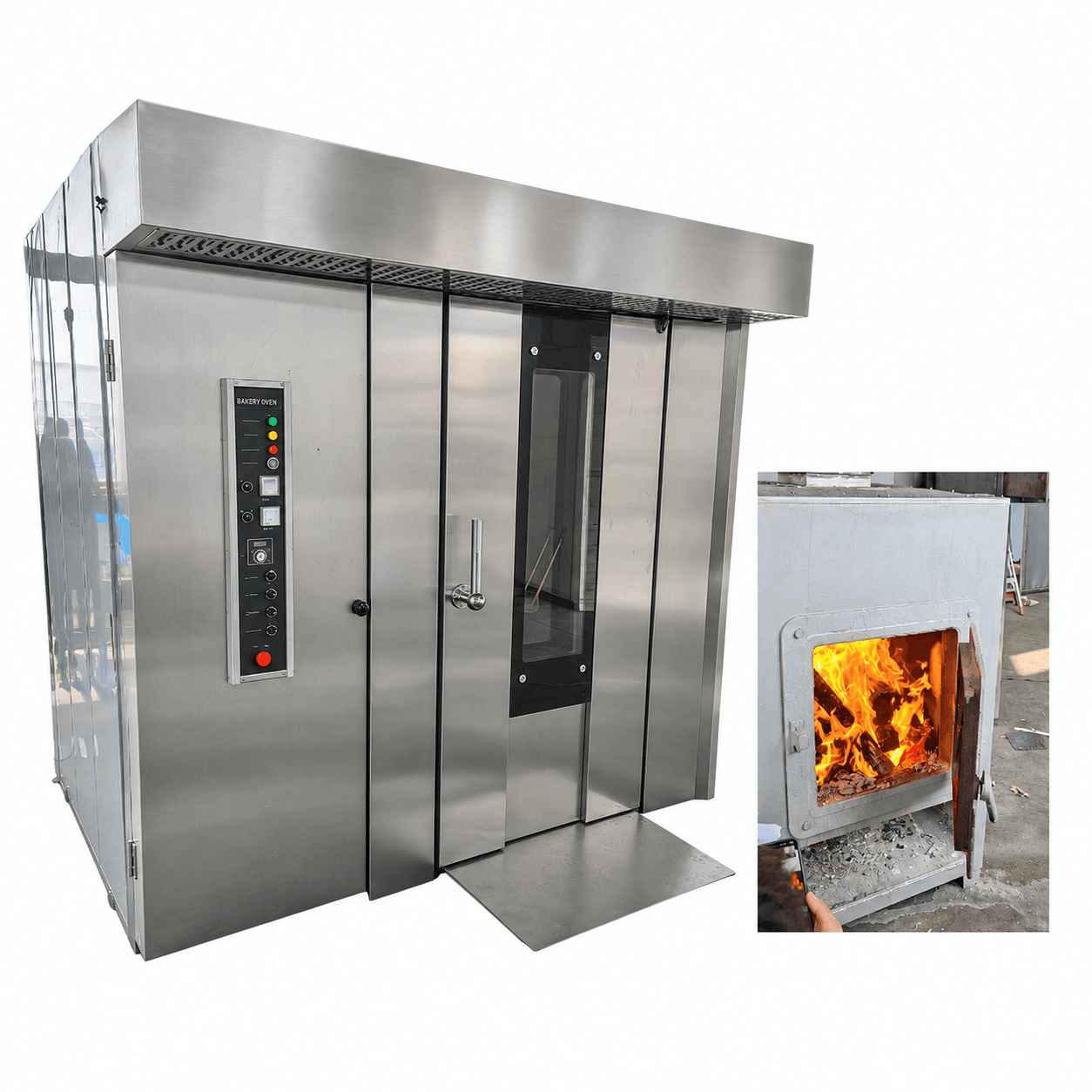
A 64-tray wood fire rotary oven suits bakeries evaluating larger batches and a firewood supply they can rely on. Before ordering, check how many saleable products you can bake per shift, how much wood the schedule requires, and how the oven fits your site. This guide covers Shanghai Hongzhong’s 64-tray wood-fired configuration.
Published specifications for the 64-tray wood fire rotary oven
| Configuration | Published baking output | Voltage | Electrical power | Firewood consumption |
|---|---|---|---|---|
| 64 trays | 200 kg/h | 380 / 220 V | 4 kW | 20 kg/h |
Use the published 200 kg/h output as a planning reference. Recipe, tray loading and bake cycle affect the result. Ask how the hourly figure is measured and confirm which voltage configuration fits your site. The 4 kW figure describes electrical power. To compare operating cost, record electricity consumed in kWh and wood consumed in kilograms over the same agreed period.
See the 64-tray wood-fired configuration in the rotary oven category
Calculate how many loads your shift requires
Start with the trays you can actually load. Count the pans that fit on one tray with enough room for the baked product and the spacing your process needs. Confirm the tray and rack dimensions against the configuration you are buying. Then group orders by recipe and bake program. Products that require different settings may need separate loads, even if both fit on the rack.
Suppose a buyer needs to bake 720 pieces and verifies six pieces per tray. A full 64-tray load holds 384 pieces, so the order requires two loads if all pieces use the same bake program. If the order consists of three recipes of 240 pieces with separate programs, it requires three loads. These are planning examples. Measure the actual start-to-start interval and final bake duration with your recipe before forecasting shift output.
Check whether the bakery can keep the oven supplied
Plot when each rack will be ready to bake. A larger oven can work well for several consecutive loads of the same product if proofing delivers enough ready trays and cooling can receive the hot output. If the bakery runs many short lots, smaller loads may fit the schedule better. Check where the next rack will wait, where the hot rack goes, and who handles both moves during peak production.
Send your product mix, tray layout and dispatch schedule for a configuration quote
Compare wood cost on the same basis as output
Calculate fuel cost from the wood actually used and the price delivered to your bakery. At a hypothetical delivered price of $0.20/kg, the published 20 kg/h consumption corresponds to $4 per operating hour for wood. For a project estimate, measure fuel weight and accepted output over the same trial window. Include preheat, routine waits and wood added between loads if those are part of your normal shift. Record any fuel carried over from a previous run so you can reproduce the measurement.
Fuel condition can also affect repeatability. The U.S. EPA’s general wood-burning guidance discusses using dry wood and checking moisture. For a commercial rotary oven, ask the manufacturer and your installer to confirm permitted fuel and operating conditions for the proposed equipment. Compare trials on the same wood supply where possible. EPA wood-burning guidance
Confirm the installation before ordering
Ask for an installation drawing showing equipment position, service access and the loading route. Have a qualified local installer review the electrical supply and the requirements for exhaust, ventilation and the combustion area. Include a practical plan for receiving and storing wood and for handling ash under the manufacturer’s instructions. Agree on who supplies and installs each part of the system. Request separate line items for the oven, any included racks or trays, site work and international freight.
For a purchase trial, agree on the recipe, number of full and partial loads, and quality criteria. Record accepted baked mass at the same point after baking or cooling. Divide accepted mass by the elapsed operating hours agreed before the run. Then calculate wood and electricity per accepted kilogram to check how the 64-tray configuration fits your production target and operating budget.
Decide whether firewood fits the operating environment
Fuel availability is only one part of the decision. Confirm that the site can receive, protect and move the expected quantity of firewood without interfering with ingredient storage or finished-product traffic. Ask the local authority and a qualified installer which combustion, exhaust, fire-safety and workplace requirements apply at the actual address. A requirement in one country, city or industrial zone should not be treated as a rule for every destination.
Write down who will prepare the fuel, feed the firebox, monitor the operating condition and remove ash. Include these duties in the shift plan. If the same employee also loads the rack, handles cooling or packs bread, test whether the assignments overlap. A fuel-price comparison that ignores labor, storage and local installation work does not represent the complete operating decision.
Build a shift-level fuel and output worksheet
Use one measurement window for fuel, electricity and accepted baked output. Record the starting and ending time, the mass of wood added, the electricity meter reading in kWh, the number of loads and the accepted mass after the same agreed process point. Keep preheat, idle time, recipe changes and shutdown visible. Do not compare a wood figure that includes preheat with an electricity figure that covers only steady baking.
- Wood per accepted kilogram = kilograms of wood added during the agreed window divided by accepted baked kilograms.
- Electricity per accepted kilogram = measured kWh during that window divided by accepted baked kilograms.
- Accepted output per operating hour = accepted baked kilograms divided by elapsed hours in the same window.
For example, if a documented trial uses 80 kg of wood during a four-hour window and produces 620 kg of accepted product, the calculation is about 0.129 kg of wood per accepted kilogram. This is an arithmetic example, not a measured Hongzhong result. Replace every number with the buyer's observed trial data before using it in a budget.
Specify the firewood and storage plan
Wood species, piece size, condition and storage can affect handling and combustion. Ask which fuel characteristics are permitted for the offered oven and keep the trial supply consistent enough to make comparisons useful. Protect the stock from rain and ground moisture, rotate inventory and keep it separated from food ingredients according to the site's own safety and hygiene plan. Do not assume that a generic moisture target or a fuel accepted by another appliance automatically applies to this oven.
For procurement, record the delivered unit, typical delivery quantity, storage footprint and the method used to weigh fuel. If fuel is bought by volume, establish how the bakery will convert deliveries into a repeatable cost record. The published 20 kg/h is a reference for the offered 64-tray configuration; representative shift measurements remain necessary for financial planning.
Plan combustion, exhaust and service access
Request a configuration-specific general arrangement drawing before preparing the room. It should show the oven footprint, firebox position, loading direction, service panels and relevant connection points. Ask for the required exhaust or flue information and have the proposed route reviewed locally. The supplier's drawing supports coordination, but local approval and installation remain the responsibility of qualified parties at the destination.
Check the complete delivery route from unloading point to final position, including gates, doors, corners, ceiling height and floor conditions. Reserve working space for loading the rack and tending the combustion system without crossing the hot-rack route. Confirm clearance and protective measures from the approved drawing and local rules instead of copying a distance from an unrelated model.
Prepare cleaning, ash handling and shutdown procedures
Ask for the operating and cleaning instructions supplied with the ordered configuration. Build a written routine for cool-down, ash removal, inspection and housekeeping around the firebox. Use suitable protective equipment and an ash container approved for the site's practice. The interval depends on the equipment, fuel and schedule, so it should be confirmed rather than invented in a general buying guide.
During a trial, observe what the operator must do between loads and at the end of the shift. Note access points, tools, hot surfaces and the time before cleaning can begin. Include those minutes in staffing and maintenance planning. If the bakery changes products with different allergen controls, document the product-contact cleaning process separately from combustion-area housekeeping.
Use a factory and site acceptance checklist
Before shipment, verify the ordered model, 64-tray configuration, nameplate supply, control functions, rack interface and included accessories. Observe door operation, rack engagement and rotation, fan and controller operation, and an agreed representative bake where practical. Record the fuel used, loading pattern, program, elapsed time and accepted result. A single attractive tray does not establish shift capacity.
At the site, confirm placement, connections, exhaust work, rack route and operator training before production release. Record unresolved items and the person responsible for each. Installation and commissioning scope should be written in the quotation; international freight, unloading, local connections and permits should not be assumed to be included.
Compare wood, gas and electric options on equal scope
A wood-fired oven is not automatically the least expensive choice, and an electric or gas oven is not automatically easier at every site. Compare delivered energy cost, local service access, ventilation and exhaust work, fuel storage, operator duties, cleaning, utility capacity and the production schedule. Ask every bidder to identify what is included and excluded.
Use measured kWh for electricity consumption and kilograms for firewood use. Do not convert rated electrical power in kW into energy cost without time and load data. When comparing other heating options, use the gas versus electric rotary rack oven guide and request configuration-specific utility information.
Information to include in the RFQ
- Products, raw piece weights, tray loading and required dispatch times.
- Tray and rack drawings, including outside dimensions and shelf spacing.
- Expected full and partial loads, shifts per day and recipe changes.
- Destination address, available electrical supply and site access dimensions.
- Proposed firewood type, delivery form, storage plan and local installer contact.
- Required trial, documentation, spare parts, packing and commissioning scope.
Ask the quotation to identify the exact equipment, included rack or trays, electrical configuration, combustion and exhaust scope, packing terms and freight basis. Keep unknown items marked for confirmation instead of converting them into assumed features.
Review the final quotation before release
Compare the final offer with the original production brief line by line. Confirm that the 64-tray wood fire rotary oven, 380 / 220 V supply option, 4 kW rated electrical power, 20 kg/h published firewood reference and 200 kg/h published output are identified for the same offered configuration. Separate published references from results that still require a buyer trial.
Record drawing revisions, payment milestones, inspection evidence, packing method, shipment terms and the documents expected before dispatch. If a value changes during engineering review, update the approved specification rather than relying on an earlier message. This creates one traceable basis for production, inspection and site preparation.
Additional buyer questions
Does the oven include the flue, installation and local approval?
Do not assume so. Ask the quotation to list the included combustion and exhaust components, installation duties and documents. A qualified local party should confirm the destination requirements.
Can I use any available firewood?
Confirm permitted fuel characteristics with the supplier for the offered configuration. Keep the trial fuel documented and consistent; local availability alone does not prove suitability.
Is international shipping free?
No free shipping is assumed. International freight is quoted separately according to destination, packing, shipment terms and the final equipment scope.
Frequently asked questions
Does the wood-fired rotary oven still need electricity?
Yes. The listed 64-tray configuration specifies 380 / 220 V and 4 kW electrical power. Ask the supplier to confirm the offered voltage, phase, frequency and connection requirements.
Should I choose 64 trays if I want to grow?
Check whether your expected larger orders can fill racks at the required pace. Include proofing, cooling space and staffing before relying on the higher catalog output.
Can I apply the published wood consumption to my annual budget?
Use it as an initial reference. Measure wood over representative shifts and apply your delivered price. Keep differences in schedule and fuel condition visible in the estimate.
Conclusion
Assess the 64-tray wood-fired rotary oven using your own pan layout, recipe schedule and delivered fuel cost. Confirm the site requirements and ask for a repeatable trial before committing to the configuration.