Buying Guide · bakery allergen changeover equipment
Bakery Allergen Changeovers: Questions to Ask Before Buying Equipment
 Written and reviewed by BelindaCEO of Shanghai Hongzhong · equipment selection and export project guidance
Introduction
When purchasing commercial bakery equipment for several recipes, compare the full changeover process before deciding that shared equipment is appropriate.
A bakery may use the same mixer, forming equipment, or depositor for several recipes with different allergen profiles. That flexibility can look attractive in an equipment quotation, but the real purchasing decision includes how the bakery will change from one product to another. Access, removable parts, cleaning methods, verification, scheduling, and product claims all affect whether shared equipment fits the intended operation.
This guide is a procurement framework for commercial bakeries and importers. It helps buyers ask better questions before selecting equipment; it is not a validated cleaning procedure or a declaration that a machine produces allergen-free food. The bakery's qualified food-safety team must determine the controls, tests, and local requirements for its products and facility. Examples are hypothetical and do not describe completed Hongzhong customer projects.
What should the equipment buyer decide first?
Start with the intended product transitions and the claims the business plans to make. “Easy to clean” is not a sufficient requirement. A transition from a milk-containing product to a recipe without milk needs a different assessment from running two products with the same relevant profile. Ingredient specifications, rework, tools, and the surrounding process also matter.
Create a product matrix with the food-safety team before requesting quotations. List the recipe, identified allergens, intended next product, proposed shared equipment, and any claims that require additional review. Use current ingredient information rather than assuming that a familiar ingredient has the same composition from every supplier.
Distinguish recipe absence from an absence claim
A recipe that does not deliberately include a particular ingredient is not automatically a product that can carry an absence claim. Shared processing and the rest of the supply chain require assessment. Ask the responsible specialist what evidence and controls are needed for the market where the finished food will be sold.
FDA describes allergen cross-contact as unintended introduction of an allergen into another food and discusses preventive controls and labeling concerns. That provides a useful United States reference, but it is not a substitute for reviewing the specific bakery or another country's requirements. FDA food-allergy information.
Compare equipment architectures around actual changeovers
Dedicated equipment or shared equipment
Ask for two operational scenarios where appropriate: a shared-machine process with an assessed changeover and a dedicated-machine process. Compare the complete consequences, including space, staffing, cleaning, verification, scheduling, and storage of tools. A second machine may reduce one sharing problem while leaving common weighing areas or utensils unresolved.
Conversely, do not assume a separate machine is always necessary or sufficient. The decision belongs to the facility's risk assessment. The buyer's role is to obtain accurate design information and make sure the proposed operation can support the controls the food-safety team selects.
Removable parts and replacement sets
Ask which components can be removed, which require tools, and how they are safely handled. A removable part is only useful if the team can clean, inspect, dry where required, store, and reinstall it correctly. A heavy assembly that needs equipment or two trained people should appear in the staffing and space plan.
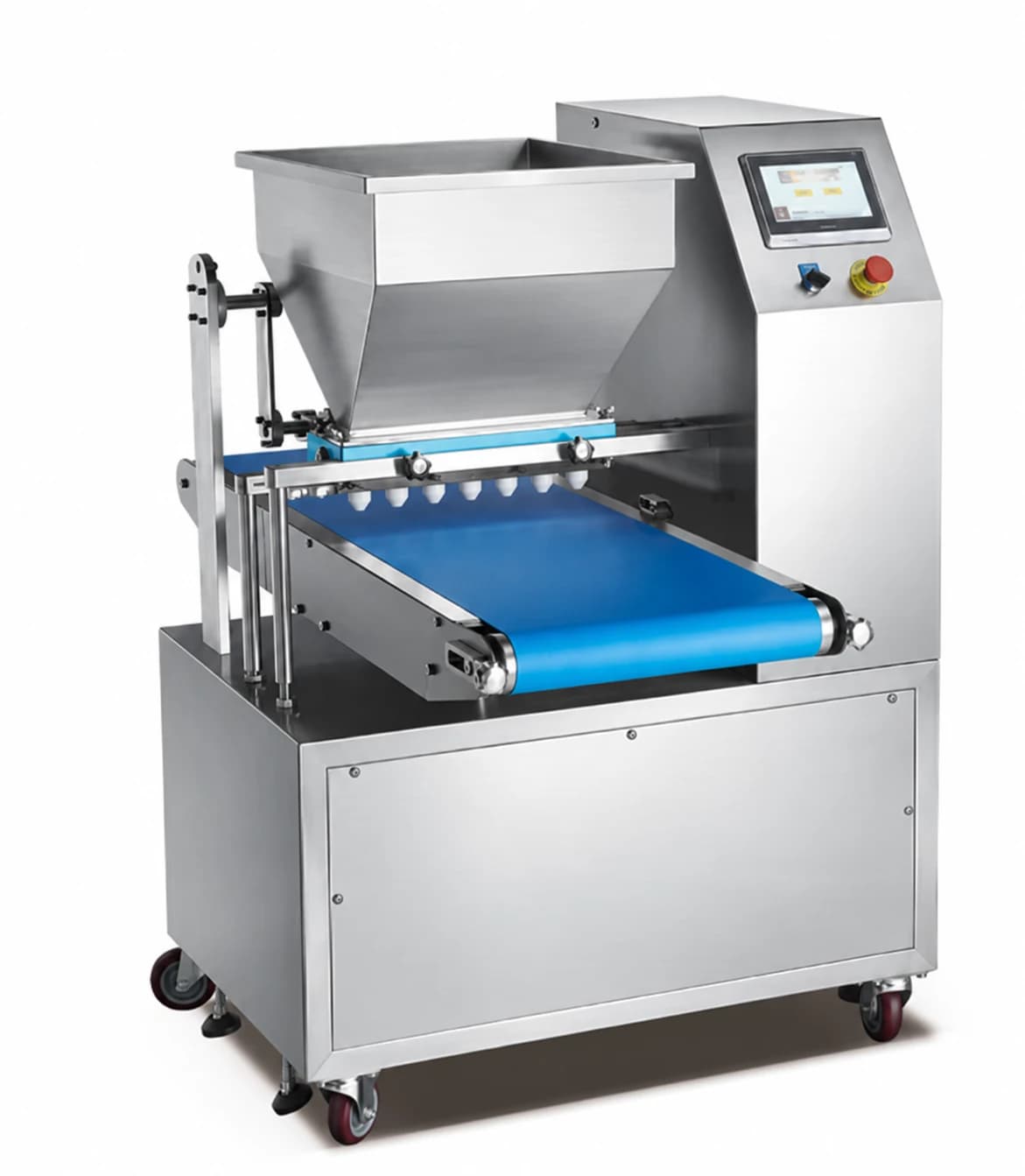
For a depositor, ask about the hopper, head, valves, nozzles, seals, and product path relevant to the quoted design. For a mixer, examine the bowl, tool, guard, discharge area, and nearby ledges. These are review points rather than a claim that every design contains the same parts or can be cleaned in the same way.
Request a product-contact map
Ask the supplier to identify the surfaces through which the product passes and any areas where residue can remain. Review the machine while assembled and during the permitted cleaning disassembly. A polished exterior photograph cannot establish the accessibility of internal product paths.
Record what is directly visible, what can be inspected after removal, and what depends on an additional method. If the supplier describes cleaning in place, request the actual scope, limitations, utilities, and supporting instructions. Do not infer a validated automatic cleaning system from the presence of a hose connection or washdown-looking surface.
Inspect the interfaces around the machine
The receiving tub, transfer conveyor, scoop, weighing table, and packaging operation may sit outside the machine quotation but inside the product process. Include them in the changeover discussion. An excellent mixer-cleaning procedure cannot resolve an unassessed transfer container that is immediately reused.
Use the existing bakery cleaning-access guide for general access questions. This article adds the separate decision about product profiles, evidence, and release between runs; it does not replace the broader facility sanitation program.
Cleaning and sanitizing are different questions
Removing allergenic food residue and controlling microorganisms are related operational concerns, but they are not interchangeable claims. FDA's retail study evaluated allergen removal and transfer under specified wiping and cleaning conditions. Its results support asking for an effective, application-specific cleaning process; they do not validate an industrial bakery machine or justify adopting one wipe as a universal solution. FDA allergen-removal study.
Ask which methods the machine allows
Obtain written instructions covering approved cleaning methods, compatible chemicals, relevant limits, and protection of electrical or other sensitive components. The bakery and cleaning specialist then need to develop a procedure suitable for the actual residue and environment. Do not specify pressure washing simply because the machine has stainless panels.
Dry and wet cleaning approaches also need facility-specific assessment. Adding water can affect areas beyond the visible product surface, while dry removal methods need suitable tools and containment. Avoid prescribing compressed-air blowing or other residue-spreading shortcuts in a generic purchase document.
Make drying and reassembly visible in the schedule
If the assessed procedure requires drying, inspection, reassembly, and release, include those activities in the planned changeover. Measuring only the time to rinse the hopper makes the usable production schedule look better than it is. Record which person performs each step and how completion is confirmed.
Ask what happens to removed seals, tools, and cleaning implements. A correctly cleaned part can be re-exposed during storage or reassembly if the surrounding arrangements are not addressed. Include suitable staging space and identification in installation preparation rather than treating them as details to solve after delivery.
Agree how cleaning effectiveness will be assessed
Separate development evidence from routine checks
The food-safety team should define how the cleaning approach is established for the equipment, product, and transition, and how ongoing execution will be checked. Use the terms validation and verification consistently in the facility's own program. The supplier can provide design and operating information, but a sales demonstration is not automatically the bakery's validation study.
Ask who selects the analytical method, sampling locations, acceptance criteria, and response to an unsatisfactory result. The answer should identify qualified responsibility, not merely a test-kit brand. Product composition, surface condition, sampling technique, and test limitations can affect interpretation.
Do not turn a general hygiene result into an allergen guarantee
Visual inspection and general hygiene tools can have useful roles, but they should not be represented as interchangeable with allergen-specific evidence. FDA's allergen-cleaning appendix cautions against using ATP alone as a specific indicator of allergen removal. That appendix is written for fish and fishery processors, so its general testing distinction is cited here without treating its full procedure as bakery guidance. FDA allergen-cleaning appendix.
If a test is negative, describe what was tested and the method's scope. Avoid a blanket marketing statement that a whole production system is allergen-free because one surface sample passed. Product claims and release decisions remain with the responsible food business.
Mid-article CTA: review cleaning access before ordering
Send your equipment and changeover requirements. Ask Shanghai Hongzhong for product-contact access information, removable-part details, cleaning instructions, and configuration limits. Share the proposed transitions with your qualified food-safety team; the inquiry is not a request for an unsupported allergen-free guarantee.
Build the changeover trial around a difficult transition
Choose a representative challenge
Have the food-safety team select the product and transition that appropriately challenge the proposed approach. The choice may involve residue behavior and cleanability as well as ingredient quantity. Do not choose the easiest recipe simply because it produces an attractive demonstration video.
Agree the trial conditions, including product exposure, operating duration, any allowed delay before cleaning, and the components being evaluated. Document departures from the agreed method. A machine that has already been partially dismantled or pre-cleaned before the clock starts does not represent the same exercise.
Observe the practical work
Record access restrictions, tools needed, part-handling difficulties, and interventions. Ask an operator to explain the steps using the supplied instructions rather than relying entirely on an expert who knows the equipment by memory. If the procedure depends on a special tool, include it in the scope and parts list.
Factory testing can establish useful design and process evidence under agreed conditions. Site assessment is still necessary when local ingredients, staff, water, cleaning materials, and layout differ. Agree which evidence transfers and what must be rechecked instead of treating either factory or site work as automatically sufficient.
| Changeover topic | Question for the supplier | Decision owner |
|---|---|---|
| Product path | Which parts contact or retain product? | Buyer and supplier review |
| Access | What must be removed, and how? | Equipment and sanitation team |
| Compatibility | Which methods and materials are approved? | Manufacturer and cleaning specialist |
| Evidence | What study and routine checks are appropriate? | Qualified food-safety team |
| Release | Who authorizes the next production run? | Responsible food business |
| Scheduling | What is the complete downtime and labor demand? | Bakery production management |
Calculate usable production time after changeovers
A theoretical machine speed does not establish the output available across a mixed-product shift. Include loading, production, cleaning, inspection, drying where needed, reassembly, verification, release, and startup. Keep labor-hours separate from elapsed downtime: two employees working together for thirty minutes use one labor-hour but only thirty minutes of elapsed time.
For a hypothetical eight-hour shift, two complete changeovers taking forty-five minutes each leave six and a half hours before other scheduled losses. This is arithmetic, not a proposed cleaning duration or equipment rating. If a supplier quotes throughput, ask whether the figure excludes changeovers and what conditions support it.
Compare the total arrangement
Consider an alternative layout or dedicated removable set only after assessing how it changes the full process. A spare hopper can shorten one step while cleaning staff, storage, drying, or release remain limiting. Price options against the actual schedule rather than assuming every spare part produces the same time saving.
Include utilities and consumables in the comparison. Water, drainage, suitable cleaning materials, testing resources, and staff training may be buyer-supplied. Equipment rated power should be stated in kW; measured operating energy belongs in kWh with defined test conditions. Neither number proves cleaning effectiveness or a sanitary design claim.
Control tools, rework, and product identification
Agree how product-contact accessories are identified and stored so operators can distinguish approved sets. Color coding may support a system, but it does not replace training, records, or a defined decision about sharing. The supplier should confirm whether additional sets are actually available for the quoted model.
Ask the food-safety team how rework is controlled and when it may be returned to production. A mechanically compatible return path does not mean every product can share it. Similarly, packaging and labels must match the released product; machine cleanliness alone does not resolve an incorrect label or an unrecorded recipe change.
Record approved configurations and update the assessment when seals, tooling, recipes, or cleaning methods change. A seemingly equivalent replacement can alter access or surface behavior. Include change notification and documentation expectations in the supplier discussion without assuming a particular certification or approval exists.
Review the relevant dough-mixer models as individual configurations. Shared category names do not establish identical access, removable parts, or cleaning methods across variants.
Prepare the purchase and handover documents
Write the equipment requirements in observable terms: accessible product path, identified removable components, permitted methods, compatible materials, and required documentation. List unresolved questions as open items rather than converting them into assumed features. Keep any certification or compliance request tied to the exact standard, scope, and evidence required by the buyer.
During shipment inspection, confirm the correct accessories, spare sets, identification, and manuals are included. During installation preparation, provide adequate space for safe disassembly and staging. At handover, confirm training responsibilities and the limits of the supplier's support. These activities need actual records before they can be described as completed experience.
Keep the commercial scope clear
Food-safety assessment, laboratory work, cleaning chemicals, local approvals, and recurring verification are not automatically included in a machine price. Request a written breakdown of supplier services and buyer responsibilities. If the equipment is imported, packing and sea freight must also be defined separately; no free-freight assumption belongs in the purchase comparison.
Keep unresolved design questions out of marketing claims
If access drawings, chemical compatibility, or test evidence remain unavailable, identify those items as pending before purchase approval. Do not turn an unanswered question into a brochure statement. The same discipline applies after a configuration change: review the actual supplied machine and operating method before reusing an earlier claim. This protects both the buyer's decision and the accuracy of future product communication.
FAQ
Can one mixer handle recipes with different allergens?
It may be possible, but the decision requires a product- and facility-specific assessment. Design access, cleaning effectiveness, verification, scheduling, and intended product claims must be considered together.
Does stainless steel make equipment allergen-free?
No. Material appearance does not establish residue removal or control across the process. Evaluate the complete product path and the bakery's approved operating program.
Is sanitizing enough between recipes?
Do not equate a sanitizing step with an established allergen-removal procedure. Obtain equipment instructions and have qualified specialists define and assess the method for the actual residue and transition.
Does a negative ATP test prove allergen removal?
Not by itself. ATP is not an allergen-specific measurement. The responsible team must choose appropriate methods, understand their limitations, and define the evidence required for release.
Should I buy dedicated tools or a dedicated machine?
Compare both options through the facility's assessment. Dedicated items can change the sharing pattern, but common weighing, transfer, storage, and staffing arrangements still need review.
What should go into an equipment inquiry?
Provide product types, intended transitions, production schedule, batch or portion requirements, proposed cleaning environment, and the design information your food-safety team needs. Sensitive recipes can be discussed under an agreed confidentiality arrangement.
Conclusion
Allergen changeovers belong in equipment procurement because they affect usable output, labor, layout, and product claims. Start with the intended transitions, inspect the actual product path, and agree how the cleaning approach will be assessed and maintained. A clear design brief supports a more useful supplier conversation than a general request for an easy-clean machine.
Final CTA: request an application-focused equipment review
Contact Shanghai Hongzhong with your product and changeover brief. Request model-specific access details, included accessories, cleaning documentation, and written limits. Use that information with your qualified food-safety team before approving shared-equipment operation or making finished-product claims.