Buying Guide · cake batter depositor buying guide
Cake Batter Depositor Buying Guide: Portion Weight, Product Quality and Line Fit
Introduction
A cake batter depositor should be selected by the batter it must handle, the required portion weight, the container or tray layout and the complete production schedule. A dosing-volume range or an attractive demonstration video cannot establish that the machine will preserve your product and deliver acceptable filled moulds at the required rate.
For an overseas bakery, the selection also affects utilities, cleaning, changeovers, spare tools and installation preparation. A machine that portions a smooth demonstration material successfully may still need a different feed arrangement or tool set for your own aerated batter or inclusion-containing recipe.
This guide explains how to prepare an application brief, compare supplier proposals and test the result through baking. It does not claim that every depositor handles every batter, particle or filling. Calculations are hypothetical planning examples, not measured Hongzhong performance or guaranteed dosing accuracy.
1. What does a batter depositor control?
Separate feeding, metering and placement
The complete operation moves batter into the metering system, controls a portion and places it in the intended position. Different designs perform those tasks differently. The label “cake depositor” does not describe the entire product path or prove compatibility with your formulation.
Ask the supplier to explain the proposed feeding and dosing method. Identify the components through which the batter passes and how the selected outlet releases the portion. This is more useful than a broad promise of multifunctional operation.
Connect machine performance to the finished cake
The purchasing objective is acceptable baked product, not merely a neat deposit. Batter condition, holding time, filling pattern and baking can all affect the finished result. A portion that weighs correctly may still produce an unacceptable cake if the process changes the batter's condition or places it poorly.
Define which product attributes matter: filled weight, position, appearance, baked volume, texture or another agreed criterion. The trial should evaluate those attributes under controlled conditions rather than treating the dosing stage as isolated from the rest of production.
Do not transfer another machine's capabilities
Bakon's BD9 technical brochure lists dosing ranges and several intended product applications for that specific equipment. It is an example of configuration-based product information, not evidence that the same ranges or materials are supported by a Hongzhong machine. Source: Bakon BD9 brochure.
Request an equivalent written application review for the actual proposal. Keep untested recipes, special inclusions and accessory-dependent functions clearly marked as requiring confirmation.
2. Prepare a useful batter description
Describe behaviour, not only the recipe name
Record whether the batter flows freely, holds a deposited shape, contains visible pieces or changes during the production period. Identify the normal temperature and the time between mixing and depositing.
“Muffin batter” or “sponge batter” is a starting description, not a complete machine specification. Similar product names can conceal different fat systems, air content, inclusions and handling characteristics. Provide the information needed for a technical assessment without publishing a confidential recipe in a public enquiry form.
Explain the process before the hopper
Describe how batter moves from the mixer to the depositor. Include containers, transfer method, holding time and refill practice. If the project includes a transfer pump or automatic feeding, identify it as a separate scope item rather than assuming it is included.
The complete product route should be reviewed where preservation of batter condition matters. Do not assume that a suitable metering head compensates for an unsuitable transfer or holding arrangement upstream.
Specify inclusions carefully
For fruit, chocolate or other pieces, provide the typical and largest expected dimensions, shape and proportion. The relevant limit can occur at a feed gap, valve, connecting passage or nozzle. One large outlet does not establish that every part of the path is suitable.
Ask for a trial using representative inclusions. Record whether particles remain acceptable and whether the distribution in the filled product is suitable. A smooth substitute mixture does not prove inclusion compatibility.
3. Understand volume, mass and portion variation
Millilitres are not grams
A depositor may be specified by a volumetric dosing range, while the bakery sells product by weight. Converting between the two requires the actual material density under defined conditions. Do not assume that one millilitre of batter weighs one gram.
For a hypothetical calculation, suppose a representative sample has a measured density of 0.8 g/ml. A 100 ml portion would then correspond to 80 g under those conditions. If the material density changes, the same volume can produce a different mass.
This calculation does not establish an equipment setting or guarantee a recipe's behaviour. It shows why sample condition and the measurement method should accompany any conversion used in a quotation or trial.
Agree what an accuracy claim means
Ask whether a quoted tolerance refers to mass, volume, a particular recipe or a defined test condition. Establish how samples are collected and which operating stages are included. Avoid accepting an unexplained percentage without a clear basis.
The average can be close to target while individual portions differ substantially. Review the agreed sample statistics and the variation between active outlets where relevant. State the calculation method if variation is expressed as a percentage.
Define acceptable product, not an arbitrary ideal
Your tolerance should reflect the product and packaging requirement and be reviewed with the supplier. Do not invent a universal dosing tolerance for every batter or machine.
If a trial result is outside the agreed range, investigate the cause and proposed correction. A different outlet, feed method or operating sequence may be needed. Record the change before accepting it as evidence for the final configuration.
4. Match the deposit to the pan or tray
Provide actual receiving dimensions
Supply the external tray dimensions, cavity layout, centre spacing, rim height and usable filling area. A nominal tray size does not define where the product must be placed or how the tray can be located and moved.
For multi-cavity pans, include a clear drawing or measured sample. Confirm the orientation in which the pan travels through the machine. A pan can fit the conveyor width while its cavity pattern remains incompatible with the selected deposit arrangement.
Define positioning and movement
Ask how the tray is located, how the deposit is triggered and what the operator does between cycles. For a line-connected system, identify the infeed, outfeed and stop behaviour. Do not assume that matching belt width proves complete integration.
Check the effect of tray variation and ordinary handling conditions. If the production system relies on a fixture or locating device, identify it in the quotation and include it in the trial.
| Application requirement | What to confirm | Evidence to request |
|---|---|---|
| Weight-based portions | Relationship between settings and actual mass | Defined sample plan using the intended batter |
| Multiple cavities | Tooling and deposit pattern | Pan drawing and filled-pan trial |
| Visible inclusions | Complete feed-path suitability | Representative recipe trial |
| Frequent recipe changes | Emptying, cleaning and setup process | Complete changeover demonstration |
| Connection to another machine | Timing, transfer and responsibility | Interface documents and handoff test |
Request an application review before choosing a dosing range. Send your requirements with batter characteristics, target portion weight, pan layout and required output. Ask the supplier to identify what can be confirmed and what needs a product trial.
5. Calculate output using the real operating sequence
For an illustrative indexed process, assume four active outlets, one portion per outlet per cycle and 15 cycles per minute. The theoretical result is 60 portions per minute. At a hypothetical 80 g portion, that equals 288 kg/h while the system runs continuously under those assumptions.
This is not a rating for any listed depositor. It excludes interruptions, rejects, pan handling and refilling unless those activities are explicitly represented in the cycle. A different machine sequence requires a different calculation.
Include hopper refilling and waiting
Record how often the hopper needs replenishment and whether production stops during the task. Identify the operator and the handling equipment required. A large hopper is not automatically better if it extends batter holding beyond the intended process.
Compare the depositing rate with available mixing and baking capacity. Increasing the former's speed may simply create filled pans waiting for an oven. The useful output is what the complete process can handle while preserving acceptable product.
Keep mechanical maximum and schedule output separate
Ask suppliers to distinguish maximum operating speed, demonstrated product output and the rate recommended for your application. Attach recipe, tooling, portion weight and run conditions to the demonstrated figure.
Build your shift estimate from the complete schedule rather than applying an unexplained utilisation percentage. Where assumptions are provisional, label them and replace them with observed results after commissioning.
6. Design a trial that supports a purchase decision
Establish the product brief first
Specify the batter or representative formulation, preparation method, entry condition, target portion, pan layout and accepted finished-product attributes. Identify normal products and the difficult applications that are important to your business.
Agree how samples will be prepared and transported. If the supplier uses local ingredients, record the differences. Do not assume that a trial using a substitute mixture establishes performance with your own flour, fat system or preparation sequence.
Observe more than stable running
Include startup, normal production, refilling, a stop and restart, and the relevant changeover. Examine whether the first portions after an interruption differ from those produced during stable operation.
Keep settings, machine identification and supplied tools attached to the accepted sample record. If the demonstration uses special tooling, identify whether it is included in the quotation. A tool visible in a video is not automatically part of the standard supply.
Follow samples through the oven
Record which filled pans came from each trial condition and assess the baked product using an agreed process. Keep the baking program and sample identification clear so differences can be investigated rather than attributed automatically to the depositor.
A polished photograph of a few cakes cannot establish the consistency of an entire run. Review representative samples and record rejected outcomes as well as favourable ones. The result should explain what the proposed system can do under the stated conditions.
7. Review cleaning and changeovers before ordering
Trace the product-contact path
Ask how the system is emptied, which components are removable and how the manufacturer permits them to be cleaned. Include the hopper, feed components, connecting passages and outlets where they are part of the configuration.
Do not assume that an accessible exterior means every internal passage can be cleaned in the same way. Obtain the operating instructions and allow space for disassembly, parts handling and inspection under the approved procedure.
Distinguish visual cleanliness from verified cleaning
For product changes involving different allergens or strong flavours, the bakery needs an appropriate cleaning and verification procedure. A short rinse or a clear-looking outlet does not establish removal of residues throughout the system.
The equipment should support your procedure, but the procedure itself needs appropriate verification. Do not describe an ordinary changeover demonstration as a validated allergen-removal test.
Include losses and setup material
Ask what happens to material remaining in the system at the end of a run. Record the time and material needed to establish an acceptable first portion after reassembly or recipe change.
These quantities affect the practical economics of short production runs. A machine with an attractive stable-run output can still be inefficient for a schedule dominated by small batches and frequent changes.
8. Confirm utilities and shipment scope
Plan the receiving team's commissioning record
Keep the accepted factory trial information available for the team that will start the machine at destination. Record the installed configuration, recipe conditions and observations from the first representative runs. Differences should be investigated against that common reference rather than judged from memory or a promotional video.
Where several operators use the depositor, agree how they record settings and product changes. A portion adjustment made to compensate for one batch should not become an unexplained permanent setting for every recipe. Clear records also help the supplier understand whether an issue appears at startup, after refilling or only with a particular product, making a technical review more useful.
Specify voltage, phase and frequency for the site. If the configuration requires compressed air or another service, request its actual requirements and identify who supplies the supporting equipment. Do not infer utility needs from the exterior photograph.
Rated power in kW is not a fixed actual-consumption figure. Measured kWh depends on the operating period and loads. If energy is important to your comparison, agree the measurement boundary rather than promising consumption from the nameplate alone.
Verify tools and documentation
During shipment inspection, compare the machine identity, electrical configuration, outlets, fixtures, accessories and spare items with the approved order. Keep accepted trial settings and product records with the handover documents.
Agree packing, international sea freight, insurance, unloading and installation support separately. Freight is not assumed to be free. Use the same named delivery basis when comparing prices.
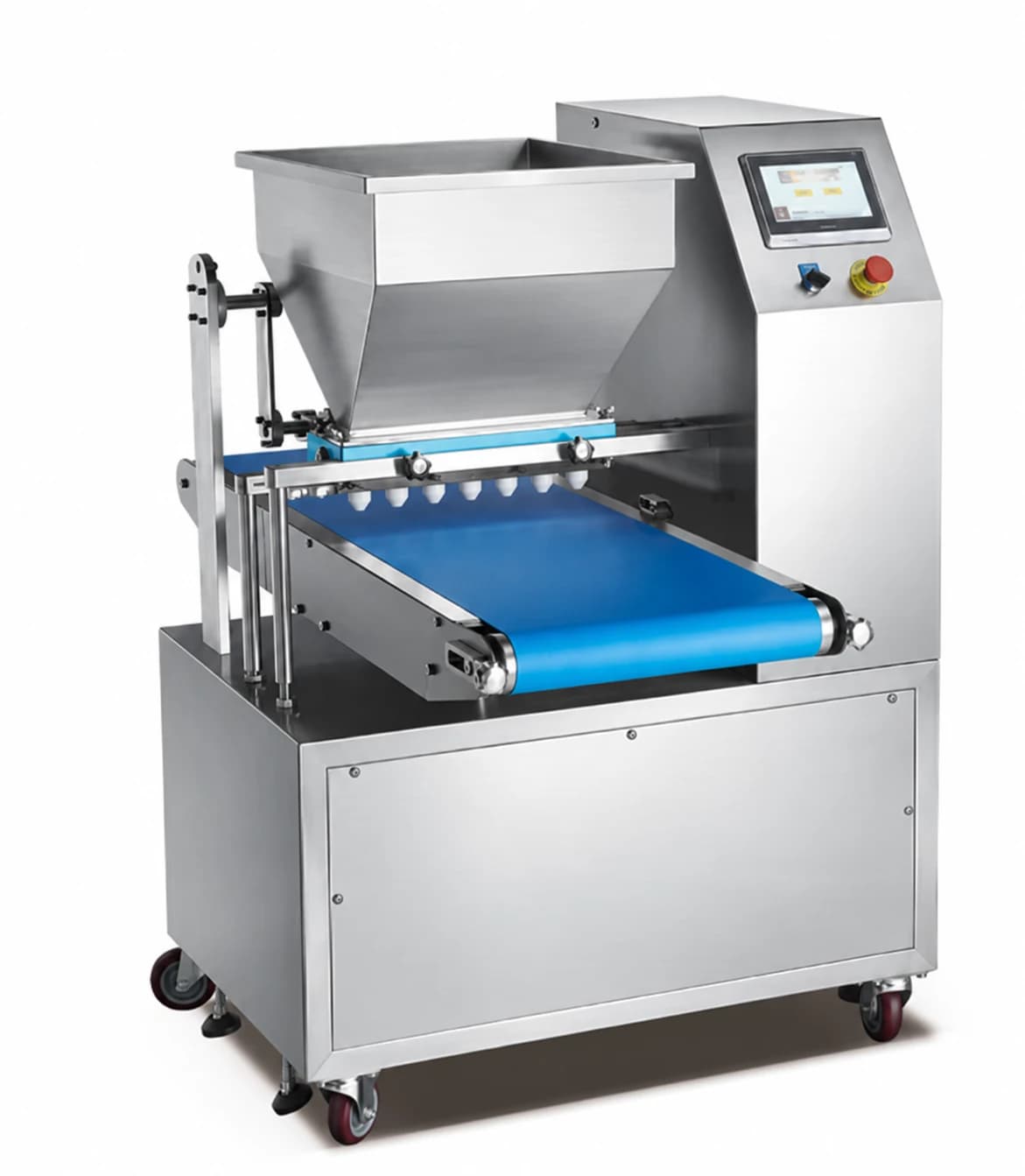
Hongzhong's listed cake and cookie depositor is a starting point for an enquiry. Its listing does not confirm every dosing system, inclusion size or product application discussed here. Confirm the actual proposed configuration in writing.
FAQ
Can a cake depositor handle any batter?
No universal compatibility should be assumed. Feed behaviour, aeration, inclusions, temperature and holding time can matter. Review the complete product path and trial the recipes that are important to your bakery before treating an application as confirmed.
Can millilitres be converted directly into grams?
Only using the relevant material density under defined conditions. One millilitre does not automatically equal one gram. Record how the sample was prepared and measured, and confirm the resulting filled weight during the application trial.
Does more hopper capacity always improve production?
Not necessarily. It can change refill frequency, but it also affects material holding and handling. Compare the hopper arrangement with the recipe's process and your batch schedule rather than selecting the largest volume without a defined need.
What should an accuracy test include?
Agree the sample plan, recipe, portion target, measurement method and acceptance limits. Include relevant operating stages and outlet positions. Review individual variation as well as the average and keep settings linked to the sample record.
What information should I send for a quotation?
Send batter characteristics, target portion mass, pan layout, required output, product-change schedule, utilities and destination. Add trial expectations and indicate which requirements remain uncertain. This lets the supplier propose a process rather than only a machine size.
Conclusion
Choose a batter depositor around the product, portion and complete line flow. Verify mass rather than assuming volume equals weight, assess the full operating sequence and follow samples through baking. Cleaning, refilling and tooling should be part of the purchasing decision from the start.
Request a batter depositing review
Contact Shanghai Hongzhong with your batter description, target weight, pan dimensions, schedule and destination. Request a configuration-specific application review and itemised quotation. Confirm product compatibility, trial arrangements, utilities and freight before ordering.