Buying Guide · dough temperature control commercial bakery
Dough Temperature Control in Hot-Climate Commercial Bakeries
 Written and reviewed by BelindaCEO of Shanghai Hongzhong · equipment selection and export project guidance
Introduction
For buyers comparing commercial bakery equipment for a hot production room, this process brief connects the mixer to the wider commercial kitchen equipment plan without assuming a particular cooling configuration.
A commercial bakery can follow the same recipe, run the same mixer timer, and still receive dough that behaves differently from one shift to the next. Flour delivered into a warm storeroom, water held in an exposed tank, and a bowl that has just finished several batches can all change the starting conditions. Buying a larger mixer does not automatically solve this problem. A better purchasing decision connects the mixer, ingredient temperatures, production schedule, and the bakery's ability to measure what happens.
This guide explains how to specify a repeatable dough-temperature process when evaluating commercial mixers for warm production environments. It is relevant to bakeries in hot regions of the United States and Africa, but location alone does not define conditions: an air-conditioned mixing room and an unconditioned warehouse need different assessments. The examples below are planning exercises, not Hongzhong test results or guaranteed machine performance.
What should a buyer specify first?
Specify the desired temperature at the end of mixing, the recipe and batch mass, the expected ingredient temperatures, and the mixing procedure. Then ask the supplier to demonstrate the proposed configuration under documented conditions. Bowl volume in liters is a useful identification field, but it does not establish the temperature outcome, allowable dough mass, or cooling capacity.
Start with your own product standard. A lean dough, enriched dough, prefermented dough, and high-rye formula do not necessarily need the same endpoint. King Arthur Baking's professional reference explains why controlling final dough temperature helps make fermentation more predictable and identifies ingredient temperatures and mixing conditions as inputs. Use that principle rather than treating a published temperature as a universal specification. Source: King Arthur Baking, dough temperature.
Write a process target, not a sales phrase
“Suitable for tropical conditions” leaves too much undefined. A useful request instead names the actual conditions: room temperature during the busiest shift, flour temperature at weighing, available water temperature, normal batch size, and the acceptable endpoint established by your baker. State whether those measurements are typical, seasonal extremes, or estimates awaiting confirmation.
Include where temperature is checked and when the clock stops. Measuring at discharge and measuring after dough has waited on a table are different observations. If several employees take readings, agree on one procedure before comparing machines.
Map the heat inputs before choosing equipment
Ingredients and storage
Measure flour where it is used, not only where it arrives. A delivery bag taken directly from a hot vehicle can behave differently from stock that has equilibrated inside. Water temperature should be measured at the dosing point. A cold-water plant reading is less useful if the water warms through an exposed distribution line before reaching the bowl.
Preferments and other substantial ingredients deserve their own records. Record actual quantities as well as temperatures so a process specialist can interpret the contribution. Do not assume the temperature calculation for a simple straight dough fully represents a formula with a large preferment or substantial fat addition.
Mixing and repeated batches
Mixing adds mechanical energy to the dough. BAKERpedia describes frictional heat during mixing, while Hobart's spiral-mixer documentation shows that recipe conditions matter when assessing equipment capacity. These are reasons to test the application, not permission to apply another manufacturer's ratings to Hongzhong equipment. Dough mixing reference; Hobart spiral mixers.
A single cold-start batch is an incomplete purchase trial if normal production runs through the morning. Ask for a repeat-batch plan that represents your intended operating pattern, within the manufacturer's stated duty limits. Record the pause between batches and any cleaning or cooling steps. Otherwise, an apparently stable result may depend on a rest period the production schedule cannot provide.
Use a water-temperature estimate carefully
A common straight-dough planning method expresses estimated water temperature as three times the desired dough temperature, minus flour temperature, room temperature, and an empirically determined mixing factor. This is a practical bakery approximation, not a complete thermodynamic model. The factor belongs to the particular recipe, machine, batch, speeds, and procedure; it is not necessarily the measured rise in dough temperature.
A hypothetical warm-room example
Assume a baker chooses a 25°C endpoint for a particular trial, measures flour at 30°C and room air at 32°C, and has established an 8°C mixing factor for that process. The estimate becomes 3 × 25 − 30 − 32 − 8 = 5°C water. Those numbers are illustrative. They are not a recommended endpoint or a Hongzhong mixer specification.
The purchasing question is whether the bakery can deliver the required water at the required rate under repeated demand. If available water is warmer, document the gap and review the process with the baker and equipment supplier. Do not hide it by changing the calculation until the quotation looks acceptable.
What if the estimate becomes impractical?
An estimate below the available water temperature signals that the proposed process needs further work. Options to investigate include ingredient storage, water chilling, room conditions, batch scheduling, and a different validated mixing procedure. Ice substitution requires recipe and equipment approval; it changes handling and must remain part of the total recipe water. Do not add ice casually or assume every mixer is approved for it.
If a preferment is used, obtain a suitable calculation from the process owner rather than applying the straight-dough example unchanged. Keep Celsius and Fahrenheit records clearly separated. An unexplained mixing factor copied from another bakery can create more error than it removes.
Evaluate mixer options by the outcome you need
Speed control and repeatable procedures
Ask which speeds are provided on the quoted model and how operators select and repeat a program. A second speed may improve process flexibility, but it does not by itself guarantee cooler dough. Compare development, endpoint temperature, and batch time together. A shorter process that leaves unsuitable dough is not an improvement.
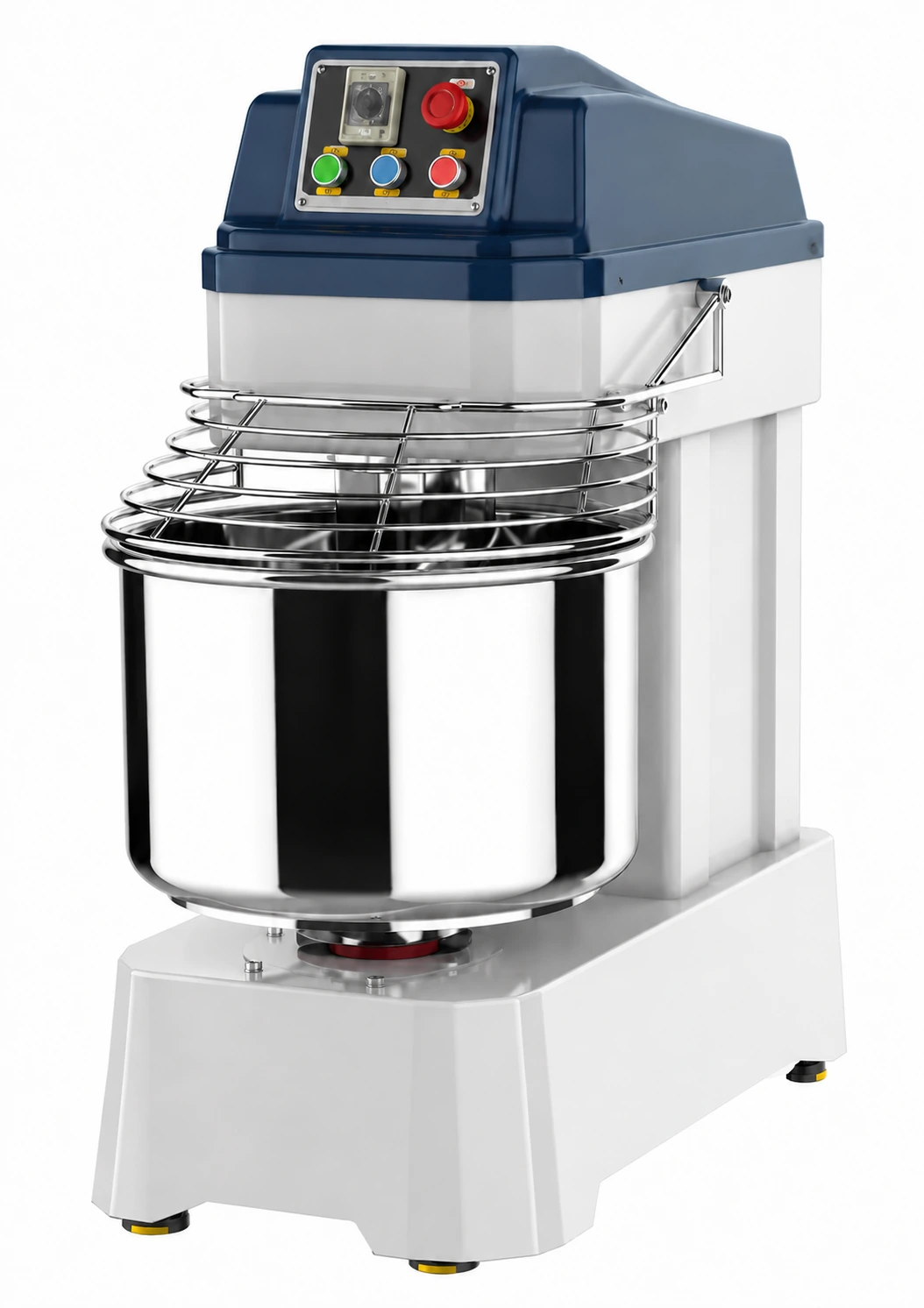
For Hongzhong inquiries, commercial dough-mixer selection starts from 60 L. Treat that as the catalog starting point, not a conversion to kilograms. Review the individual models and confirm the recipe-specific working load before purchase. Browse dough mixers.
Bowl design, discharge, and optional cooling
Ask whether the offered bowl is fixed or removable, how discharge is performed, and whether the machine includes any actual temperature-control hardware. A stainless bowl is not a chilled bowl. A jacket, sensor, water chiller, or automated dosing system must be identified separately, with its limits and installation needs. Do not infer these options from a photograph.
Also establish what happens after discharge. Dough can wait while another machine is occupied, making a well-controlled mix difficult to use consistently. Coordinate the transfer and forming sequence instead of judging the mixer as an isolated purchase. The existing mixer-to-makeup transfer guide addresses that separate interface.
Mid-article CTA: send a temperature brief
Send your requirements to Shanghai Hongzhong. Include recipe type, normal batch mass, target endpoint, measured flour and water temperatures, destination power supply, and planned batches per shift. Ask for a configuration review and an agreed product application trial; temperature-control options and performance must be confirmed in writing.
Build a trial sheet that produces a purchasing decision
Record the conditions before starting
Prepare one record per batch, including recipe revision, ingredient masses, initial temperatures, machine identification, selected speeds, and planned timing. Name the person responsible for measurement. Use a suitable food probe and the bakery's approved hygiene and checking procedure. Measurements from different instruments should not be compared blindly when their accuracy has not been checked.
Agree what information the supplier can share before sending a confidential recipe. A simplified trial formula may support an early discussion, but it should not silently become the final acceptance recipe if it behaves differently from production dough.
| Trial field | What to record | Why it affects the decision |
|---|---|---|
| Recipe and batch | Revision and actual ingredient masses | Makes results comparable |
| Starting temperatures | Flour, water, room, preferment where relevant | Describes the thermal conditions |
| Mixing sequence | Speeds, durations, additions and pauses | Identifies the tested procedure |
| Endpoint | Temperature, development assessment and discharge time | Connects process to usable dough |
| Repeated operation | Batch number and time since previous discharge | Reveals dependence on scheduling |
| Downstream wait | Time to dividing or forming | Distinguishes mixing from transfer issues |
Inspect the dough as well as the thermometer
The target is dough that meets the product requirement, not merely a number on a screen. The baker should assess development and handling using the agreed method, then follow the batch through its intended process. Record whether extra intervention was necessary. An operator adding unplanned water or extending mixing can invalidate a comparison unless those changes are documented and accepted.
Agree how a failed trial will be handled: repeat under corrected conditions, revise the configuration, change the operating brief, or decline the application. A documented limit is more useful than an attractive but unrepeatable demonstration.
Plan utilities for a warm production room
Water chilling, if required, is a separate utility project. Request the supplier's water demand, inlet conditions, connection details, and compatible treatment requirements. Have a qualified local contractor assess the installation. Storage volume alone does not prove a chiller can recover quickly enough between batches.
Electrical information should include voltage, frequency, phase, and the final equipment nameplate. Rated power is stated in kW. Actual energy consumption is measured in kWh under defined operating conditions. Do not calculate a promised daily consumption simply by treating every connected load as continuously operating at its rating.
For a hypothetical schedule, four batches each requiring 15 L of chilled recipe water create 60 L of recipe-water demand. This arithmetic says nothing about chilling capacity because inlet temperature, desired outlet temperature, timing, losses, and other users remain unknown. Use it to start a utility brief, not to size refrigeration equipment without engineering review.
Assign responsibilities before shipment
Make the process assumptions part of the order review. Who provides chilled water? Who confirms the recipe endpoint? Who verifies the local electrical supply? Who trains the operators and retains the trial records? Explicit ownership prevents the mixer supplier and local installer from each assuming that the other party included an essential utility.
Factory testing should document the actual configuration and recipe conditions. Shipment inspection should confirm model identification, included accessories, protective packing, and required operating documentation. Installation preparation should confirm access, utilities, and safe operating clearances. None of these activities should be described as already completed unless the corresponding records actually exist.
Commission the procedure, not only the motor
At startup, repeat the agreed measurements using local ingredients and realistic ambient conditions. Compare the data with the factory record, noting differences rather than expecting identical numbers from a different environment. Train operators to record deviations and escalate unexplained temperature changes instead of compensating by guesswork.
Keep a simple trend log through the first operating period. Batch identity, starting temperatures, endpoint, and intervention notes are usually more useful than an unstructured collection of photographs. The log can reveal a water-supply limitation or a scheduling problem without immediately blaming the machine.
Compare quotations using the same thermal brief
Send each supplier the same recipe envelope and environmental assumptions. Ask them to distinguish standard equipment, optional cooling or dosing equipment, buyer-supplied utilities, and items that need a trial. Compare the complete proposed process instead of ranking quotations only by bowl volume or motor power.
Include commissioning support and any remote review of trial records as explicit commercial line items. State what technical documentation will be supplied and which measurements the buyer must collect. If sea freight is required, obtain the shipping scope and charges separately; it should not be assumed to be free.
Use a two-shift comparison to locate the problem
Consider a hypothetical bakery whose early batch meets its approved endpoint but whose afternoon batch finishes warmer. Instead of immediately requesting a larger motor, compare the records in order: ingredient temperatures, actual batch mass, selected speeds, mixing duration, and the wait before measurement. Check whether the afternoon operator measures at the same point in the process. This sequence separates a different starting condition from a different operating procedure.
If the flour and water are warmer but the machine sequence is unchanged, the purchasing discussion may need to focus on ingredient conditioning. If the initial temperatures match but the operator extends mixing, investigate why the dough needs that intervention before selecting a cooling option. If the endpoint is acceptable at discharge but unsuitable after waiting, examine the downstream schedule. More than one cause can be present.
For an importer evaluating several offers, turn these findings into a short exception list. Ask each supplier which observed conditions their proposal addresses, which remain the buyer's responsibility, and which require additional trial evidence. A quotation that names its limits is easier to evaluate than one that simply promises consistent dough in every climate. Keep the completed comparison with the recipe revision so a later product change triggers a deliberate review.
FAQ
Does a larger mixer keep dough cooler?
Not automatically. Temperature depends on the recipe, initial conditions, working load, machine design, and mixing procedure. Test the proposed model at a representative batch size rather than inferring performance from bowl volume.
Can I use one water setting throughout the year?
Only if the process evidence supports it. Changing flour, room, or preferment temperatures can require a different water setting. Use the bakery's approved measurement and adjustment procedure.
Is the mixing factor the same as the temperature rise?
Not necessarily. In the practical estimation method described here, it is an empirical term derived for a defined process. It should not be replaced automatically with a measured temperature difference or copied from another machine.
Does every commercial mixer accept ice?
No such assumption should be made. Confirm equipment compatibility and recipe handling with the supplier and baker. Any ice used must be accounted for within total recipe water and the validated process.
Can a 60 L model be selected from flour weight alone?
No. Provide the complete recipe and batch mass, including hydration and substantial additions. Have the supplier confirm the working range for the proposed configuration; liters do not directly establish a dough-weight rating.
What should I send for an initial review?
Send product type, batch mass, recipe outline, target dough temperature, measured ingredient temperatures, production schedule, destination, and electrical supply. Identify estimates so they can be verified before acceptance criteria are agreed.
Conclusion
Dough-temperature consistency is a process requirement that should shape mixer selection, utility planning, and acceptance testing. Begin with measured ingredients and a product-specific endpoint, then compare equipment using the same documented procedure. A repeatable trial and clear ownership of cooling utilities are more valuable than an unsupported promise about hot-climate performance.
Final CTA: review your mixer application
Ask Shanghai Hongzhong for a mixer application review. Share your batch, recipe outline, site conditions, and intended production schedule. Request written confirmation of the proposed model, actual included options, trial scope, and separate delivery charges before placing an order.