Buying Guide · industrial bakery equipment
Industrial Bakery Equipment: Plan Capacity Around Accepted Output
 Written and reviewed by BelindaCEO of Shanghai Hongzhong · equipment selection and export project guidance
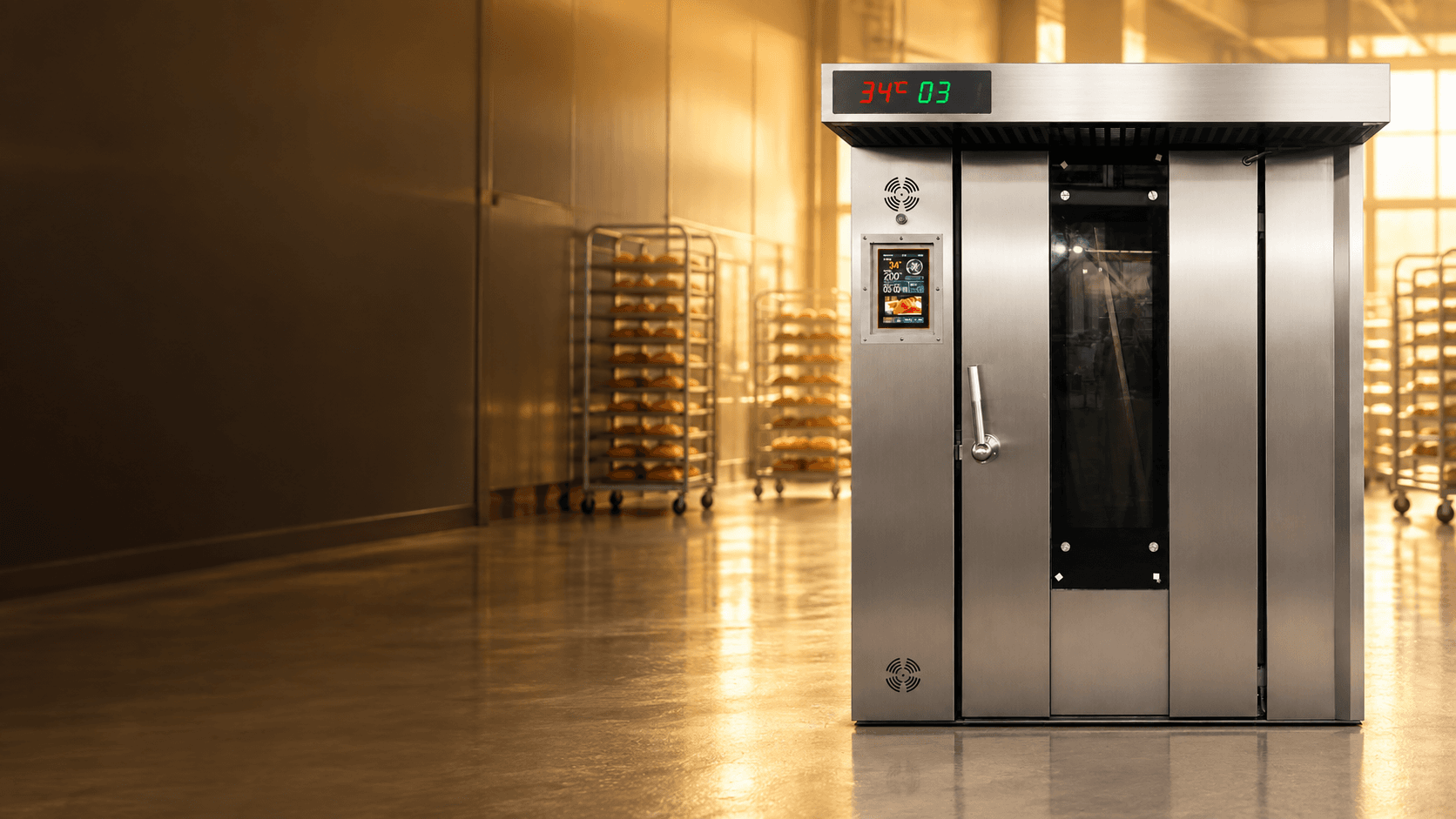
Industrial bakery equipment should be selected as a connected production system, not as a list of machines with unrelated maximum ratings. The useful question is not which mixer, former or oven has the largest catalog number. It is how many saleable products the full line can deliver inside the required dispatch window while maintaining the recipe, size, bake and packing standards agreed by the buyer.
This guide gives overseas bakery owners, project engineers and importers a practical way to prepare an equipment request. It focuses on line balance, evidence and site readiness. It does not assume that one published capacity applies to every dough, product weight or operating schedule.
Define accepted output before choosing industrial bakery equipment
Start with finished products. List each product family, target piece weight, daily quantity, peak dispatch time, number of production days and acceptable quality criteria. Separate products that use different dough systems, proofing programs, tray formats or bake profiles. A daily total can hide the real requirement: a bakery may have twelve hours available but need most of its bread ready before the morning delivery vehicles leave.
Use accepted output rather than theoretical pieces. Accepted output excludes pieces outside the agreed weight, shape, proof, bake or packaging criteria. For an initial plan, record raw dough per batch, expected process loss and finished saleable quantity separately. During a trial, weigh and count at defined points so that the supplier and buyer calculate performance on the same basis.
Build a product-and-shift matrix
Create one row for each product. Useful columns include batch size, pieces per batch, trays per batch, mixing time, rest time, dividing and forming time, proofing time, bake time, cooling time, changeover time and the required completion time. Mark which products can share tools or settings and which require a full clean. This matrix reveals whether the project needs one flexible line, parallel stations or separate production windows.
A planning spreadsheet is not a performance guarantee. Its purpose is to expose assumptions. If the piece weight, dough temperature or bake cycle is not verified, label it as an input to confirm during a product trial.
Find the bottleneck across the complete bakery line
Compare each process using the same time window. A mixer may be described in kilograms per batch, a divider in pieces per hour, a proofer in tray positions and a rotary rack oven in trays per load. Convert these figures into the product and shift plan before comparing them. Include loading, unloading, scheduled cleaning, normal pauses and recipe changes.
If a 60 L or larger dough mixer prepares dough faster than the divider can receive it, adding mixer capacity creates waiting dough rather than finished bread. If the forming section supplies racks faster than the proofer or oven can accept them, the line needs controlled buffering. If the oven releases a full rack but cooling and packing have no space, the baking section cannot maintain its planned rhythm.
Review Hongzhong commercial bakery equipment categories
Use start-to-start cycle time
For batch processes, measure the time from the start of one batch to the start of the next comparable batch. This includes the actions needed to discharge, reload and restart. For continuous processes, measure accepted output over a representative interval and record planned stops. Use the slowest sustainable handoff as the initial line rate, then test whether buffers and staffing can support it.
Specify the mixer and dough handling section
For bread dough, state flour weight, total dough weight, hydration range, target dough temperature and batch frequency. Hongzhong’s commercial dough mixer range starts at 60 L, so a project should confirm whether the intended batch fits the selected bowl and whether the next process can receive the dough safely. Do not select only by nominal bowl volume.
Describe how dough leaves the mixer. A small line may transfer tubs manually. A larger industrial bakery equipment project may need a lifter, hopper or other transfer arrangement. Confirm discharge height, receiving height, access for cleaning and the maximum mass handled at one time. Any lifting or guarding arrangement must be reviewed for the actual configuration and local requirements.
Match dividing, rounding and moulding to the product
Send representative dough and finished-product information before approving forming machinery. State the raw weight range, shape, inclusion size, dough condition, resting time and required surface finish. A divider should be evaluated by individual piece-weight results across a run, not only by its nominal speed. A rounder or moulder should be checked for product appearance and internal structure after baking.
If one line will make several breads, identify the most difficult products. A very soft dough, a firm dough and a product with inclusions may require different settings or tools. Ask the supplier to document the setup used for each sample. Features such as wire cutting, filling or special tooling should be included only when they are confirmed for the offered machine.
Size proofing and baking as a coordinated system
Proofing capacity must reflect tray count, product height, program duration and the oven loading schedule. Count the trays that enter during one proofing cycle and the trays that must be ready for the next oven load. Include a practical allowance for loading and unloading, but do not hide unverified production assumptions inside a large percentage.
For rotary ovens, compare 16-, 32- and 64-tray configurations using the actual tray layout and bake program. Hongzhong publishes planning outputs of 50 kg/h, 100 kg/h and 200 kg/h for those model groups, but recipe, tray loading and cycle time affect actual output. Treat the figures as references to verify, not universal promises.
Compare 16-, 32- and 64-tray rotary rack ovens
Calculate utilities and operating cost correctly
Ask for rated electrical power in kW for the quoted configuration. Estimate measured electricity use in kWh only from a defined operating profile or test. Record preheat, production, idle time and shutdown separately when comparing alternatives. For gas, diesel or wood-fired heating, record fuel quantity, delivered fuel price and accepted product over the same period.
Provide destination voltage, frequency, phase, fuel type and available service capacity in the request for quotation. A label such as customizable voltage is not a substitute for a configuration-specific electrical schedule. Have qualified local personnel confirm the final supply, protection, ventilation, exhaust and combustion requirements before installation.
Plan cleaning, allergen control and maintenance access
Industrial bakery equipment must fit the buyer’s sanitation program. Ask which parts contact food, how tools are removed, where residues collect and how the machine is accessed for cleaning and inspection. The U.S. Food and Drug Administration’s current good manufacturing practice rules require food-contact surfaces to be adequately cleanable and maintained to protect against contamination; destination requirements and the bakery’s own hazard controls still govern the project. Review 21 CFR Part 117
Include cleaning and recipe changes in the capacity plan. A line that runs quickly but requires a long, difficult changeover may deliver fewer accepted products in a mixed shift. Request a list of routine wear parts, lubrication points where applicable, access clearances and the information needed to identify replacement components.
Prepare a factory acceptance test for the connected line
The factory acceptance test should refer to the approved configuration. Verify model identifiers, voltage, controls, guards, included tools, racks, trays and accessories. Run the agreed product or a clearly identified representative material. Record input, settings, elapsed time, individual weights or dimensions, accepted output and unresolved observations.
Test handoffs as well as individual machines. Observe how dough enters the divider, how pieces transfer between stations, how trays are loaded, and how racks move through proofing and baking. A short demonstration does not establish an annual output figure, but it can confirm that the supplied interfaces operate as agreed.
Send your product matrix and peak dispatch requirement for a line review
Compare quotations on equal scope
Use one requirement table for every supplier. Separate included equipment, optional tools, racks and trays, installation materials, documentation, factory testing, packing, international freight and destination services. Sea freight should be quoted separately unless the commercial offer explicitly states otherwise.
Mark every open item. If a supplier cannot yet confirm output for your recipe, request a trial plan instead of accepting an unsupported number. If local installation or commissioning is excluded, identify who will perform it and what documents they need. A transparent scope is more valuable than a low headline price with missing interfaces.
Frequently asked questions
What is the difference between commercial and industrial bakery equipment?
The terms overlap. Industrial usually describes higher-throughput, connected or more automated production. The correct selection still depends on product mix, shift schedule, utilities and accepted output rather than the label.
Should every machine have the same hourly capacity?
No. Batch timing, buffers and cleaning schedules affect the balance. Compare each process across the same production window and identify the sustainable bottleneck.
What should I send for an industrial bakery line quotation?
Send product and dough information, target piece weights, quantities and dispatch times, tray format, room drawing, utilities, destination, cleaning requirements and the functions that must be demonstrated.
Can catalog capacity be used for a financing forecast?
Use it only as a preliminary reference. Build the forecast from a representative trial or documented assumptions and show allowances, rejects, changeovers and operating hours separately.
Conclusion
Choose industrial bakery equipment by tracing accepted products through the complete shift. When the product matrix, interfaces, utilities, cleaning plan and acceptance evidence are clear, the buyer can compare configurations without confusing isolated machine speed with real bakery output.