Buying Guide · rotary oven baking uniformity test
Rotary Oven Baking Uniformity: How to Plan a Full-Load Test
 Written and reviewed by BelindaCEO of Shanghai Hongzhong · equipment selection and export project guidance
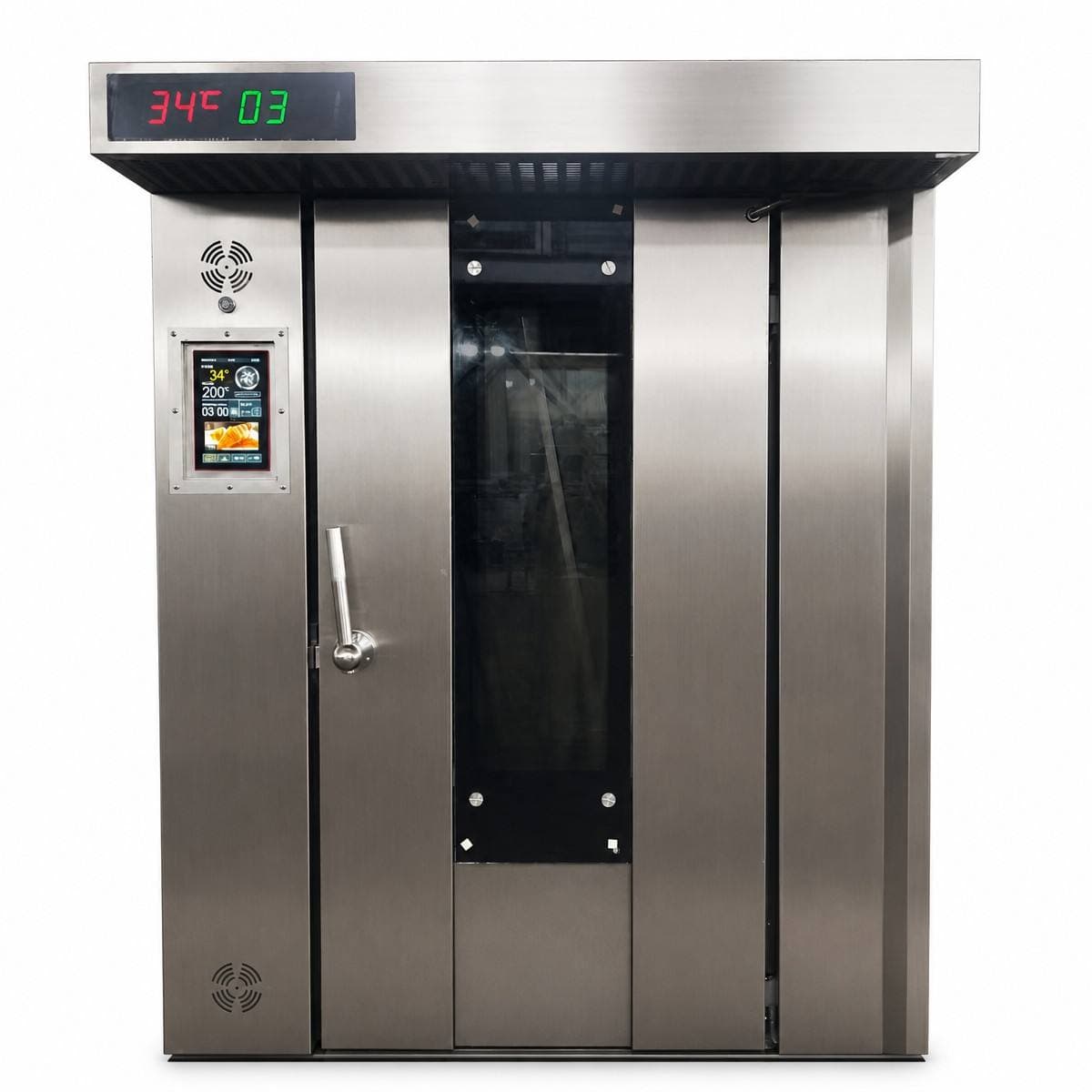
A rotary oven baking uniformity test should show how a defined product bakes across a loaded rack under recorded conditions. It should not be reduced to one photograph of attractive bread or a statement that the oven heats evenly. Buyers need a repeatable plan that controls dough, tray loading, settings, timing and evaluation.
This guide explains how to prepare a full-load test before shipment and how to repeat the important checks after installation. It applies to rotary oven and rotary rack oven projects, including different tray capacities and heating configurations. Exact procedures must follow the offered model, manufacturer instructions and destination safety requirements.
Define what uniformity means for the product
Uniformity is a product result, not only an air-temperature reading. Define the acceptable range for color, internal bake, moisture or weight loss where relevant, volume, crust, shape and defects. A cake, tin loaf, bun and cookie need different criteria. Ask the bakery’s quality team to approve the method before the test.
Use measurable categories where practical. A color chart, mass measurement, dimensions and cut-section photographs can support visual judgment. Do not create a tolerance that the bakery has never used merely to make the test look scientific.
Distinguish within-tray, between-tray and between-batch variation. The test layout should make those patterns visible. If several differences are combined into one average, a problem at the rack top or one tray edge can disappear.
Select a representative test product
Choose a product that reflects the intended oven use and is sensitive enough to reveal variation. Use the buyer’s normal recipe when shipping ingredients or dough is practical and permitted. Otherwise, agree on a documented substitute and state what the substitute can and cannot prove.
Record ingredient lot, dough temperature, mixing, resting, piece weight, forming, proof conditions and time between preparation and loading. Uneven dough or proofing can produce uneven color and volume even when oven conditions are stable.
For mixed-product bakeries, one test may not cover the range. Select a small group that represents different baking demands, such as a high-moisture loaf and a small low-mass item. Identify which products remain untested.
Confirm the exact rotary oven configuration
Record model, tray capacity, rack type, tray size, heating source, voltage, frequency, controls and steam or water function. Confirm whether the rack uses a hook, platform or another interface and whether the test rack is the one supplied with the order.
A 16-, 32- or 64-tray description does not establish identical airflow, footprint or loading practice. Use the approved configuration. If a twin-body or pass-through arrangement is involved, prepare a test that reflects its actual doors, chambers or operating sequence.
Verify nameplate and safety-related items before heating. Qualified personnel should conduct the test, and the manufacturer’s operating procedure should govern startup and shutdown.
Control trays, pans and rack loading
Use trays or pans with the same dimensions, material, surface and condition where comparison is intended. Dark, bright, perforated, solid and coated trays can produce different heat transfer. Record any intentional variation rather than mixing trays without explanation.
Define pieces per tray, spacing, orientation and empty margins. Use a loading map with rack level and tray position. If the normal bakery leaves some levels empty, test that operating pattern as well as a full rack where relevant.
Check that trays sit correctly and do not obstruct rotation or interfere with the chamber. Confirm loaded rack mass and wheel condition are within the approved arrangement. Existing racks should not be used until dimensions and support interfaces are verified.
Stabilize the process before the comparison
Follow the documented preheat procedure and record the indicated set point and elapsed time. Do not assume that reaching the display temperature means every surface or air path has stabilized. Use the manufacturer’s ready condition and a consistent loading delay.
Prepare products so the first and last tray do not differ materially in proof or resting time. If loading takes several minutes, record the sequence. A staggered preparation plan may be needed for a large rack.
Keep door-open time consistent and record any interruption. Do not adjust temperature, steam or fan settings midway unless the test protocol calls for a programmed stage. Unrecorded corrections make position comparisons difficult.
Create a rack position map
Assign each tray a level number from bottom to top and mark front, back, left and right orientation. If the rack rotates continuously, the map still matters because vertical position and local tray geometry can affect results. Mark sample pieces on each tray.
Use a grid that follows the product. For cookies, compare edge, center and corners. For bread pans, compare pan positions and loaf ends. Avoid taking only the best-looking piece from each tray.
| Test layer | Record | Question answered |
|---|---|---|
| Process | Dough, proof, loading and settings | Were input conditions comparable? |
| Rack | Level and tray orientation | Is there a vertical or directional pattern? |
| Tray | Edge, center and corner samples | Is variation within one tray? |
| Product | Color, mass, dimensions and defects | Does the result meet acceptance criteria? |
| Batch | Repeat run and recovery condition | Is the result repeatable? |
Record settings and time correctly
Record set temperature, displayed temperature at defined points, programmed stages, steam command, fan or airflow setting where adjustable, rack rotation and total elapsed time. Do not report a temperature graph as proof of baked-product uniformity without product results.
Measure actual bake time from the agreed event, such as door close or program start, and use the same definition for comparisons. Record unloading sequence because product left on hot trays can continue changing.
If independent temperature instruments are used, document instrument type, placement and calibration status. Sensors can disturb airflow or read radiant effects depending on location. Qualified personnel should interpret the data.
Evaluate product results without hiding variation
Arrange samples according to the rack map and photograph them under consistent lighting. Record unacceptable pieces and the reason. Calculate a range or position pattern for measured properties rather than publishing only an overall average.
Look for repeatable patterns: darker top levels, pale centers, one tray edge, differences near the door or variation associated with pan type. One unusual piece may come from dough preparation; a repeated positional pattern deserves investigation.
Keep acceptable appearance tied to the buyer’s product standard. A darker crust may be desirable for one market and a defect for another. The test should not substitute the manufacturer’s preference for the buyer’s specification.
Test heat recovery and consecutive batches
A first batch after a long preheat may not represent production. Where the project requires repeated racks, run a defined consecutive-batch test. Record the interval between unloading and reloading and whether the same program and load are used.
Observe displayed recovery and product results in the next batch. Do not convert recovery time into guaranteed hourly output without including rack exchange, product preparation and planned stops.
If the bakery operates partial loads, test a representative partial rack separately. Do not assume settings proven at full load will automatically suit a half load.
Check steam or moisture functions with the right product
If steam is included, define water supply, pressure, treatment and the command used during the test. Evaluate the product response, such as crust development or surface condition, rather than reporting only that steam was visible.
Record the interval between steam-demanding batches. The ability to issue a command does not prove identical effect during rapid consecutive loads. Discuss recovery and water requirements for the intended schedule.
Water quality and treatment are site-specific. Follow manufacturer instructions and qualified local advice. Do not infer water treatment requirements from another installation.
Compare heating sources on equal conditions
Electric, gas, diesel and confirmed wood-fired configurations can require different site arrangements and operating procedures. A product test on one heating source does not prove the behavior or consumption of another configuration. Use the ordered system or label the evidence as a family reference.
When evaluating operating inputs, measure electricity in kWh and fuel quantity over the same defined window, including agreed preheat and waiting periods. Rated electrical power remains kW. Keep accepted output in the same window before calculating input per accepted unit.
Do not publish a fuel or energy saving without a comparable baseline, measurement method and product load. Local fuel quality, climate, ventilation and operator practice can affect results.
Investigate a failed uniformity test methodically
First confirm input consistency: piece weight, proof, tray type, spacing and loading time. Then review rack position, door operation, rotation, settings and the documented procedure. Do not immediately change multiple variables.
Repeat a controlled portion of the test after one justified adjustment. Keep before-and-after records. If the issue involves the machine or configuration, record the corrective action and repeat the relevant full-load condition before acceptance.
Never bypass a guard or interlock to observe operation. Use manufacturer-approved inspection methods and qualified personnel.
Write acceptance criteria before the test
The buyer and supplier should agree on product, load, settings, number of runs, measurements, sample positions and pass criteria. State what happens if ingredients or destination products are unavailable at the factory. Identify who approves the result and how open items are closed.
Separate machine-function acceptance from product-process development. The oven can pass agreed mechanical and control checks while a recipe still needs optimization. Conversely, an attractive sample does not replace verification of safety functions, configuration and included accessories.
Compare Hongzhong rotary rack oven capacities and model pages
Document the factory test for shipment handover
Keep the approved test protocol, product data, loading map, settings, results, photographs and action list. Add the machine model, serial or unit identifier where available, date and participants. Photograph the nameplate, rack, trays and included accessories.
After acceptance, preserve relevant settings and identify any parts removed for shipment. Packing photographs should show the actual unit and labels. Do not represent test photographs as proof of a customer installation or shipment when they are not.
Send your product, tray layout and quality criteria for a rotary oven test-plan review
Repeat essential checks after installation
Factory results do not replace site commissioning. Confirm that the oven is level, utilities and exhaust are approved, rack movement is correct and controls operate as documented. Differences in voltage, fuel, water, ventilation or installation can affect operation.
Run a representative site batch after operator training. Use the factory map as a reference but record local ingredients, proof conditions and room environment. Close installation issues before changing the recipe repeatedly.
Store the final test and commissioning records with the model documentation. They provide a baseline for training and future troubleshooting, not a permanent guarantee that maintenance and process control are unnecessary.
Relate the test to oven capacity selection
A larger rack can increase pieces per batch only when mixing, forming, proofing, loading, cooling and packing support it. Compare 16-, 32- and 64-tray configurations with the same product assumptions: pieces per tray, accepted trays per batch, cycle time, rack exchange, planned changeovers and shifts. Do not multiply tray count by an ideal cycle and present it as guaranteed daily output.
Uniformity evidence also affects capacity. If the bakery needs to reduce loading density or leave levels unused for one product, usable output differs from a theoretical full rack. Record the proven pattern for each representative product and plan the schedule accordingly.
Consider rack preparation and waiting. A larger oven may need multiple racks in circulation so one can be loaded, another baked and another cooled. Measure the floor area and movement route, including proofing, oven approach and cooling positions. Confirm that doorways, ramps and floor joints allow safe movement under load.
When comparing a single larger oven with multiple smaller ovens, include product flexibility, redundancy, staffing, utilities and service access. Two ovens may allow independent programs but require more connections and operating coordination. One larger oven may simplify a high-volume product but create a more important production bottleneck. The full-load test provides evidence for product behavior; it does not decide the complete business case alone.
Convert the approved test into an operating baseline
After commissioning, turn the accepted loading map, recipe settings and observation method into a controlled production record. Operators should know which tray, rack and product variables must remain consistent and which adjustments require supervisor approval. Keep the baseline concise enough to use during a shift.
Create a first-piece or first-batch check appropriate to the product. Compare labeled samples with the approved standard and record deviations early. This is not a substitute for the bakery’s food-safety or quality system; it is a practical link between the equipment trial and routine operation.
When results drift, compare current conditions with the baseline: ingredient and dough temperature, proof, piece weight, tray condition, load map, program, door time and maintenance status. Escalate machine-related observations with model information, photographs and records. Avoid changing several settings at once.
Review the baseline when trays, recipes, rack loading, utilities or maintenance work change. Keep the old revision and reason for change. A well-documented test becomes useful training and troubleshooting evidence, while an unlabeled photograph quickly loses value.
Frequently asked questions
Does rack rotation guarantee even baking?
No. Rotation supports exposure, but product preparation, loading, airflow, settings, tray type and oven condition also affect results. Verify with a mapped product test.
How many trays should be used?
Use the agreed representative operating load. A full-load test is valuable for rated use, while partial-load behavior may require a separate test.
Can temperature probes replace a product test?
No. They can support diagnosis, but baking uniformity must be evaluated in the product under controlled conditions.
Should every tray be photographed?
Record enough labeled evidence to preserve the rack pattern. For a critical acceptance test, a complete mapped set is preferable to selected attractive samples.
Can one recipe prove all products?
No. Choose representative products and state the limits of the evidence. Products with materially different mass, moisture or baking profiles may need separate trials.
Conclusion
A useful rotary oven baking uniformity test controls inputs, maps the complete rack, records settings and evaluates product against agreed criteria. It also checks repeatability and recovery rather than relying on a single display reading or photograph. This evidence helps the buyer approve the configuration and creates a stronger baseline for commissioning.