Buying Guide · rotary rack oven buying guide
How to Choose a Rotary Rack Oven for Your Bakery
Choosing a rotary rack oven is not simply a question of buying the largest machine available. The right oven must match daily output, product mix, tray format, utility supply, staffing, floor space and expected growth.
Start with the bakery workflow
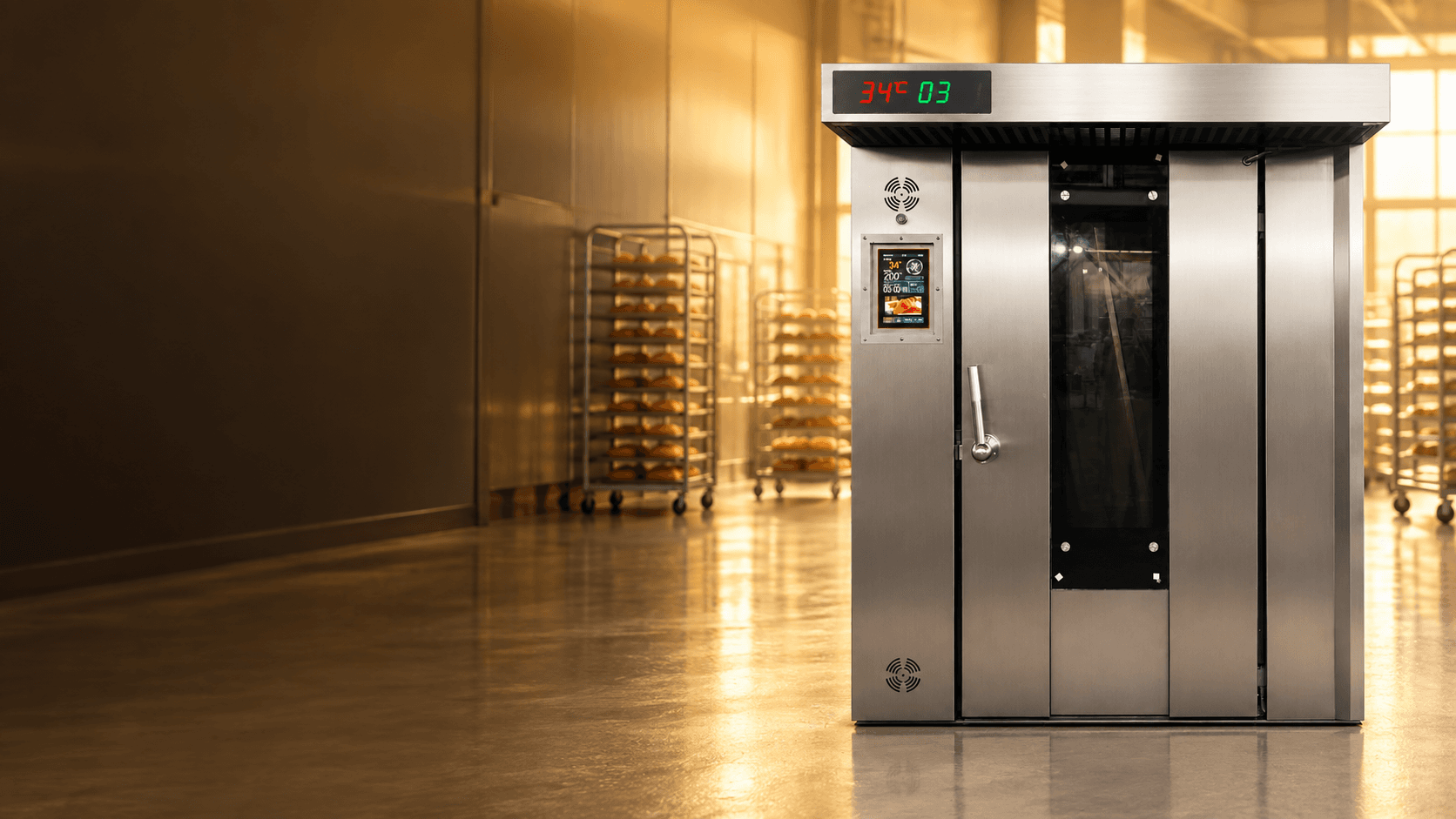
A rotary rack oven bakes a wheeled rack of trays inside a circulating hot-air chamber. Its value is not only the rotating rack; it is the ability to organise a repeatable workflow from tray loading and proofing through baking, cooling and packing.
Before comparing models, map the actual shift: which products are baked, how many trays are needed per batch, how long each cycle takes, and where a prepared or finished rack will wait. An oven cannot remove an upstream proofing bottleneck or a downstream cooling bottleneck.
32 tray versus 64 tray
A 32-tray configuration is often a practical choice for commercial bakeries that need meaningful batch capacity while changing between product types. It can fit bakeries producing bread, buns, pastries, cakes or cookies through a mixed daily schedule.
A 64-tray model can suit central kitchens, wholesalers and industrial bakeries when demand is stable enough to keep a larger rack productive. Before selecting it, confirm access route, ceiling height, ventilation, utilities, proofing capacity, cooling space and staff handling. Larger capacity is useful only when the complete line can support it.
Confirm tray and rack compatibility
Tray count alone does not define usable baking area. Ask for the exact tray dimensions, rack dimensions, shelf spacing and product-height clearance. Existing 600 × 400 mm trays may be compatible, but this should be confirmed rather than assumed.
Give the supplier your tray dimensions, product height and any requirement for racks to pass through proofers, ovens, cooling areas or doorways. This allows the quotation and layout drawing to reflect the real production system.
Check energy and site readiness early
Electric, gas and diesel configurations should be selected according to local utility availability, operating requirements and service capability. For electric projects, confirm voltage, frequency, phase, available load and panel capacity. For gas projects, confirm gas type, inlet pressure, exhaust route and local safety approval requirements.
Request a layout drawing before production. It should identify the equipment footprint, service clearance, door direction, rack path, connection points and exhaust position. Installation preparation should begin during quotation, not after the container arrives.
Use a configuration-specific factory test
A useful factory acceptance test verifies the ordered model, energy configuration, voltage, tray or rack arrangement, controller, safety functions and accessories. Ask to observe door operation, rack rotation, fan operation, controller settings and any agreed steam function.
The strongest process combines the approved specification, a factory test checklist, photographs of the nameplate and accessories, packing photographs and shipment documents. This is more meaningful than relying on a generic product video.
Frequently Asked Questions
Is a 32-tray oven enough for a wholesale bakery?
It can be, depending on product weight, batches per shift, proofing capacity, operating hours and growth plans. Use the bakery's own production plan rather than tray count alone.
What is needed for a quotation?
Share product type, target capacity, tray size, energy source, voltage, frequency and destination country.
Can tray sizes be customised?
Discuss the exact tray and rack requirements before production so compatibility can be confirmed.
Plan Your Bakery Equipment Project
Send your product type, output target, tray size, voltage, fuel preference and destination. Shanghai Hongzhong can help compare suitable 32-tray, 64-tray, double-door or pass-through configurations.
Get a Quote →