Buying Guide · commercial bakery proofer capacity planning
Size Proofer Capacity Before Buying a Bakery Line
Size a proofer from the trays that must be in proof at the same time, not from the oven's tray count alone. A buyer needs the production schedule, proof duration by product and transfer pattern before asking a supplier to propose a chamber or rack arrangement.
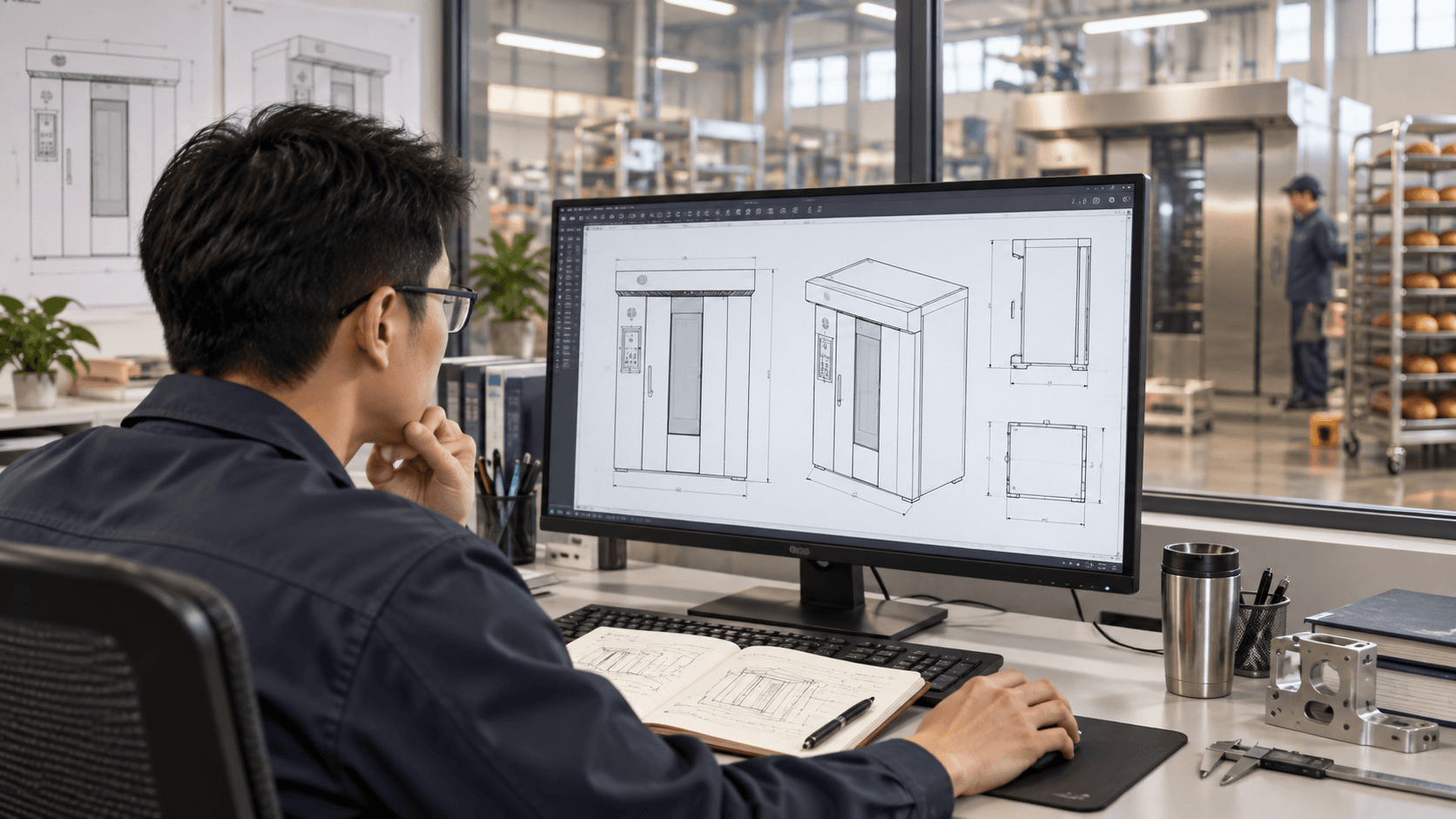
Start with the busiest production window
List each product, the trays required for the dispatch window, the expected proof period and the interval at which trays enter proof. Identify products that share a chamber and those that need different conditions or timing. A daily total can hide a short period when several batches compete for space.
Use a representative schedule rather than a single advertised capacity figure. Include tray loading, rack movement and the time needed to clear the chamber between product groups. If the schedule is uncertain, mark assumptions for a trial instead of treating them as guaranteed throughput.
Calculate simultaneous tray demand
For a steady product flow, divide the planned trays per hour by the number of loading events per hour, then count how many loads remain in proof before the first exits. For mixed products, draw a time chart and count occupied rack positions at each point. The maximum simultaneous occupancy is the capacity question the supplier must answer.
Allow space for the actual rack and tray geometry. Nominal tray slots do not establish whether tall products have enough clearance or whether the same rack moves through proofing and baking. Ask for usable dimensions, rack interface and the loading pattern permitted for the selected configuration.
Check the handoff to the oven
Compare the proofer exit schedule with oven loading and bake cycles. If several proofed racks become ready together, the bakery needs a defined holding or sequencing decision; dough quality can change while it waits. Conversely, an oven that finishes before a rack is ready may sit idle despite apparently adequate tray capacity.
Draw the full route from forming to proofing to baking. Confirm door widths, turning space, trolley handling and whether racks are shared or transferred between systems. A layout should show where an incoming rack waits and how operators avoid crossing the hot unloading path.
Put testable assumptions in the RFQ
Send the supplier your product schedule, tray dimensions, rack drawing if available, expected proof conditions, site utilities and room dimensions. Ask for the proposed usable rack positions, operating arrangement, connection schedule and general arrangement drawing. Have the production team review the assumptions before approving a purchase.
Specify how capacity will be checked during commissioning with representative products. Product proof time depends on formulation and process conditions, so a chamber's nominal rack count is not a promise that every recipe will meet a dispatch target. Keep the acceptance method tied to the agreed product schedule.
Frequently Asked Questions
Can I match proofer trays to oven trays one for one?
Only after mapping proof duration, oven cycle time and the number of overlapping batches. A simple one-to-one count can miss queues.
What if products need different proof conditions?
Schedule separate runs or request a configuration that can support the required conditions; do not assume one chamber can serve incompatible recipes at once.
What should I send with a proofer RFQ?
Send product mix, peak tray schedule, tray and rack dimensions, room plan, utilities and the intended oven handoff.
Continue planning
Plan Your Bakery Equipment Project
Share your peak production schedule, proof times, tray size and room plan. Shanghai Hongzhong can discuss a proofer and oven sequence against those project inputs.
Get a Quote →