Buying Guide · rotary rack oven ventilation RFQ
Define Rack Oven Ventilation Before Ordering
A rack oven RFQ should identify the exact oven and fuel configuration, then assign responsibility for the hood, exhaust path, fan, controls interface and local approval. Leave these items open and the equipment quote may not describe an installable oven.
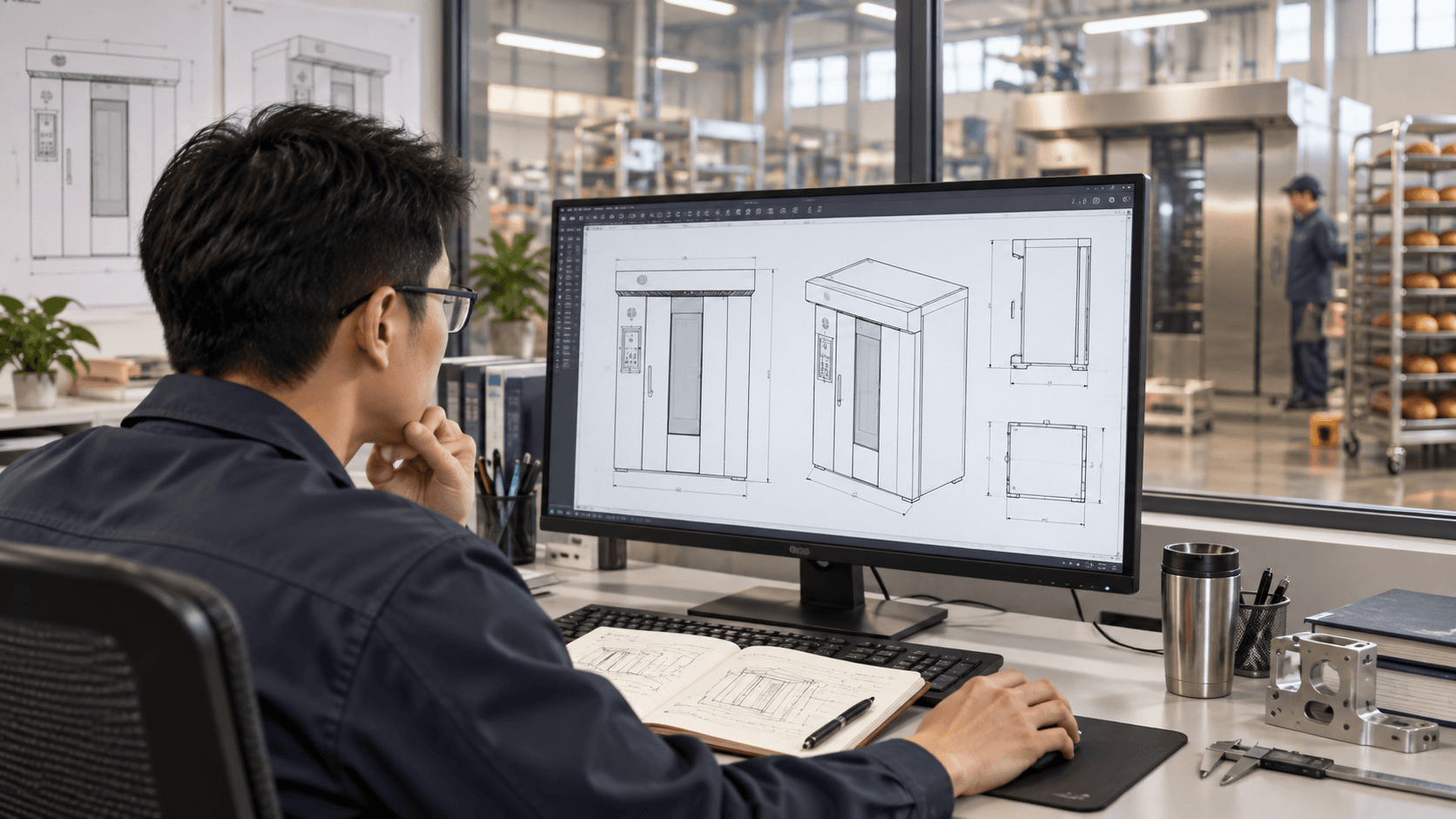
Start with the ordered oven, not a generic hood
Ask the supplier for the proposed model's installation drawing and ventilation schedule. Record whether the oven is gas or electric, where combustion products or chamber vapor leave it, and which connections are included. A hood specification from another model is only an example.
For instance, Baxter's gas rack oven sheet assigns a hood vent connection and a customer-supplied duct and fan. Its dimensions and airflow apply to that Baxter configuration, not to a Hongzhong oven. Obtain the actual offered model's requirements in writing.
Map the exhaust route on the bakery layout
Show the oven position, ceiling height, service access, hood location and route to the building discharge point. Ask the local ventilation designer to check the duct path, available space and make-up air. Make-up air is replacement air supplied as exhaust leaves the room; without a coordinated design, the fan may not perform as intended.
Identify who will size and install the duct, fan and any roof or wall penetration. State whether local fire, building or food-service approvals apply. The responsible local professionals must confirm the design against current local rules, rather than treating a supplier drawing as a permit.
Define controls and commissioning boundaries
Ask whether the proposed oven needs a fan-proving signal or another interlock before heating can start. A proving signal tells the oven controller that the required exhaust system is operating. The control logic and wiring must follow the actual machine documentation.
Put responsibility for electrical connections, controls testing and final ventilation measurements in the project schedule. A qualified installer should document the result before the oven is released. Do not assume a running fan alone proves that the complete exhaust route works.
Compare quotations on the same scope
For each bidder, mark hood, duct, fan, controls interface, design drawings and local installation as included, excluded or assigned to another contractor. Request a clear drawing revision and list of open assumptions. This makes a lower oven price easier to interpret when the site work differs.
Use the site power assessment guide for the separate electrical load question, and the line layout guide for rack movement and adjacent equipment. Ventilation needs its own named owner and acceptance record.
Frequently asked questions
Can I use an existing kitchen hood?
Only after a qualified local designer checks the offered oven, capture arrangement, duct route and applicable approvals.
Does an electric rack oven need no ventilation plan?
No. Ask how the proposed electric oven handles heat and vapor, then confirm the site design for that configuration.
What belongs in the final RFQ?
Include the oven model and fuel, drawing, connection points, ventilation scope, local contractor responsibilities and commissioning evidence.
Ask about your project
Send the proposed oven configuration and a site drawing. Ask Shanghai Hongzhong to identify the oven-side ventilation connections and open installation questions before quotation.