Buying Guide · small bread production line
Small Bread Production Line: Equipment Checklist for a Commercial Bakery
 Written and reviewed by BelindaCEO of Shanghai Hongzhong · equipment selection and export project guidance
Introduction
A small bread production line starts with a schedule: the loaves you need to pack, their sizes, and the time they must leave the bakery. For many buyers, the first list of commercial bakery equipment includes a dough mixer, forming tools, a proofer and a rotary oven. The configuration depends on the product. A pan loaf that will be sliced and bagged has different handling needs from a crusty roll sold whole. A wholesale order due at 7 a.m. creates a different constraint from the same volume spread across a retail day.
This guide uses an illustrative pan-bread order to show how to specify the equipment, labor and handoffs for a small operation. The calculations are planning assumptions. They do not represent measured Hongzhong machine performance. Replace them with data from your own recipe and trials before ordering.
What equipment does a small bread production line need?
For pan bread, plan ingredient weighing, mixing, dividing and shaping, final proofing, baking, depanning and cooling. Add slicing and packing when the sales format calls for them. Benches, pans, racks, scales and staging space are part of the plan. The equipment list is incomplete if it shows a mixer, proofer and oven but leaves nowhere to weigh dough, hold a hot rack or store empty pans.
Decide which steps can start with manual work
Keep a manual step when an operator can meet the required pace and repeatability under the expected workload. Manual weighing and shaping can be practical for a limited assortment or an operation still refining its recipes. Time these activities with normal staffing. Include the interruption when a second operator leaves the bench to unload an oven. If piece weight varies beyond the product specification, dividing can become a higher-priority investment than a larger mixer.
Match a divider or moulder to the products you actually sell. Take a recipe sample and record the dough temperature, piece weight range, rest time and expected loaf shape. For pan bread, send the internal pan dimensions and a photograph of a correctly shaped piece in the pan. A machine that handles a heavier test dough may still need separate validation on a sticky or delicate formula. See the dough forming equipment category for relevant configurations.
Work backward from the shipment window
Start with packed, saleable loaves. Separate the packing deadline from the baking deadline. Subtract the cooling time established for your product, then account for depanning, handling, slicing and bagging. Work backward again through baking and proofing. This exposes a common scheduling problem: the last load may fit within the oven shift while finishing too late for the delivery van.
Example: a 600-loaf order
Assume an order of 600 packed loaves, each made from a 0.55 kg dough piece. For illustration, plan 2% process loss between scaling and packing. Divide 600 by 0.98 and round up to 613 pieces, or about 337 kg of scaled dough. The loss assumption covers this example only. If your own losses occur before scaling, such as dough left in the mixer, account for them separately. Do not apply the same allowance twice.
Suppose a recipe trial validates a 45 kg batch for the chosen mixer and recipe. Seven full batches produce 315 kg. The remaining 22 kg requires a smaller validated batch, a different batch split or an agreed plan for surplus. A bowl labeled in liters provides no direct answer to this issue. Check the supplier's permitted range for your actual dough, including the smallest batch you expect to run. Hobart's capacity chart illustrates why published mixer capacities are application-specific. Its numbers apply to Hobart equipment. Reference: Hobart spiral mixer capacity chart.
Now assume a verified layout of four loaf pans per tray and a planned 40-minute interval between oven loads, including normal handling. A 16-tray load would hold 64 pieces under these assumptions. Ten loads would be needed for 613 pieces. The tenth load starts 360 minutes after the first and still needs its own bake time. A 32-tray load holds 128 pieces on paper, so five loads cover the same pieces if enough dough is ready. The fifth load starts 160 minutes after the first under the assumed interval. Check the interval independently for each configuration. A larger load may change handling time, heat recovery and the recipe schedule.
These calculations describe what the example needs from a line. They are not a promise that four pans fit every tray or that either oven can complete the stated cycle on your recipe. Confirm external pan dimensions, spacing for airflow, baked loaf height and rack shelf clearance. A partially filled rack should also be included in any trial if that is how the bakery will end a shift.
Compare the machines at their actual handoff points
Mixer to dividing and forming
Ask where each batch lands when mixing ends. Note the discharge height, bench or container capacity, and how dough reaches the scale. Time one entire cycle from the first ingredient loading to the point when the mixer is ready for the next batch. Include discharge, operator travel and the cleaning steps required between recipes. If two loaves use the same base dough, write down the point where they split into different weights or shapes so the forming plan reflects the real operation.
Get the mixer quote in terms that can be checked: configuration, rated power in kW, validated dough mass per batch, required supply, and included bowl or tool accessories. If the purchase decision depends on operating electricity, ask how kWh will be measured over a defined set of cycles. Rated power and measured energy answer different questions. See the commercial dough mixer category for the current range.
Forming to proofing
Estimate how many trays reach the proofer during one oven interval, then compare that with how long the trays occupy the cabinet. For example, if the plan sends a 16-tray group every 40 minutes and the trial calls for 60 minutes of proofing, two groups overlap for part of the schedule. A cabinet with space for only one group cannot maintain that cadence without changing the sequence. Allow time for loading and recovery, and check what happens when a batch reaches proof readiness early.
Confirm whether the proposed cabinet takes trays individually or accepts a wheeled rack. A rack-in proofer and oven may accept different racks even when the pans look identical. Request the rack and opening drawings, and record whether the product will be transferred between systems. Set temperature and humidity requirements with your baker and verify them in a representative load. Review the proofing equipment category when preparing the layout.
Preparing an equipment list? Send your bread recipe type, piece weight, pan dimensions and packed-loaf target so the mixer, proofer and oven can be reviewed against the same production schedule.
Proofing to the rotary rack oven
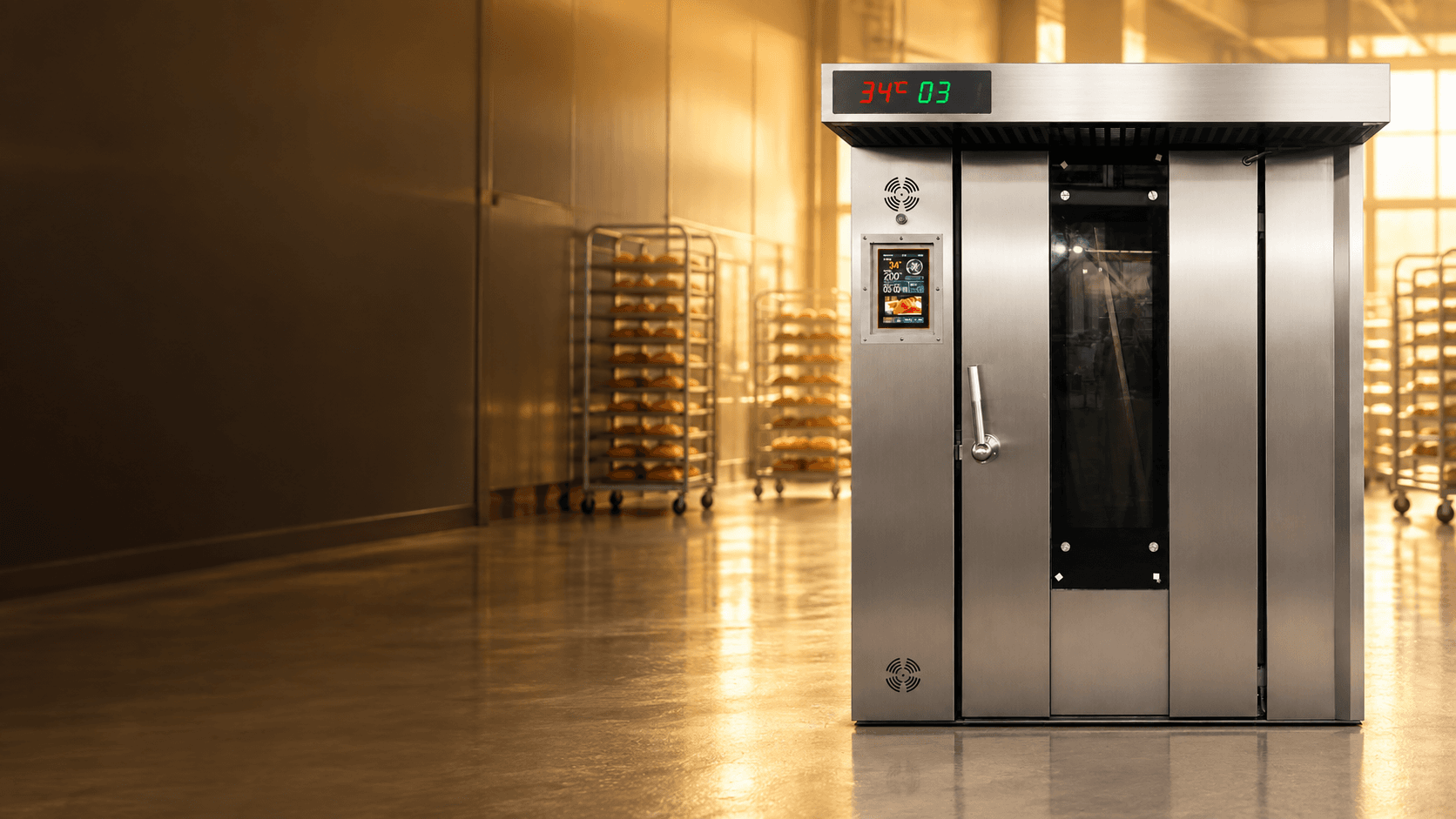
Choose the rotary oven capacity that fits the schedule and the flow of ready trays. A smaller rack can suit several recipes with different proofing times. A larger rack becomes easier to use when the bakery can build full loads of the same product and move the hot output downstream. Compare the published rotary rack oven range and the 16-tray, 32-tray and 64-tray detail pages against the trial. Review the 64-tray twin-body model as a separate configuration, including its access and utility requirements.
Compare quotations using the same bread, tray arrangement and load sequence. Ask how the operator will know when a rack can go in, and where the next ready rack will wait. Include a route for the hot rack that does not depend on moving the waiting rack out of the way. If the quote lists gas, diesel or electric options, verify the one proposed for the installation in writing and have a qualified local installer check the site requirements.
Oven to cooling, slicing and packing
Work out cooling capacity in occupied spaces, not just minutes. If racks arrive every 40 minutes and a validated cooling process holds each rack for 90 minutes, three groups can be in cooling at once. If racks are freed by depanning to another surface, size that surface separately. Agree on a practical release check with your baker and validate it for the loaf, ambient conditions and packaging format. Starting the slicer earlier to clear a queue can change product quality and should be evaluated during the trial.
If slicing is required, test the intended slice thickness and packaging workflow with fully cooled loaves. Record the acceptable slice condition, saleable loaves per observed interval, change time between loaf sizes and cleanup. Include time for the person who bags and labels the bread. A commercial bread slicer can be evaluated against the pace of the packing station instead of the supplier's headline speed alone.
What should be in the first purchase order?
Separate what the line requires on opening day from what is useful when volume rises. For example, a bakery may need the correct pans and enough cooling space immediately, even if it plans to divide manually for the first season. If the shop sells mostly unsliced bread, space and a utility provision for a slicer may be adequate at first. If a retailer requires sliced, labeled loaves by a fixed dispatch time, slicing and packing belong in the opening-day plan.
Specify which interfaces the supplier will cover. Ask whether the price includes racks and trays, any tools for the recipes, required installation parts, manuals and spare parts. Record who handles unloading, equipment placement and connection. International freight is quoted separately for the destination and agreed shipment terms. Compare freight and installation separately from machine price so the totals represent equivalent scopes.
Draw the equipment positions on a plan showing actual door widths and the route from the unloading point. Mark power, water and any fuel or ventilation connections that require professional review. Use the opening widths and service clearances for the proposed machine rather than generic figures from a layout drawing. If the site is in the United States, ask your installer to confirm the exact supply and applicable requirements. Do the same for each African destination and each facility. Country names alone do not establish the supply available at the installation point.
Use a trial to confirm the equipment list
Bring a recipe sheet, ingredients where practical, your pans or approved samples, the intended order profile and a definition of a saleable loaf. Agree on the number of batches and who records time and quality. Follow the equipment instructions and use qualified personnel for safety and installation checks. Mark every assumption that could not be tested, such as the buyer's cooling conditions or the destination power supply. Those assumptions belong in the follow-up before the order is finalized.
Record the time each step starts and ends, the number of acceptable pieces and where trays wait. Compare the results against the same dispatch target used for the quote. If the dough arrives faster than the proofing cabinet can accept it, add proofing capacity or change the sequence before expanding the mixer. If packed output is late because the loaves wait for cooling space, budget for racks or a different staging plan. The bottleneck should be visible in the trial record.
Frequently asked questions
Can I buy one bread making machine, or do I need a line?
Ask the supplier to list the steps the quoted machine actually performs. A dough mixer prepares dough. A divider or moulder handles pieces after mixing. Proofing, baking and cooling still need their own equipment or work areas. If a quotation uses the phrase “bread making machine,” request a line-item list of the included machines, racks, pans and tooling, and identify every step your staff will do by hand. This makes a single-machine quote comparable with a packaged line.
Can I start a small bread production line without an automatic divider?
Yes, if manual dividing meets the piece weight tolerance and schedule with normal staffing. Check a representative order from mixing through packing. If one operator also loads the oven, include that time in the trial.
Is a 16-tray rotary oven enough for a small bakery?
It depends on verified pans per tray, the actual time between loads, product mix and the shipping window. Calculate full and partial loads for the busiest order. Confirm the plan against proofing, cooling and packing capacity.
How do I compare an industrial bread production line with a small line?
Compare saleable output over the same period, the number of products, changeovers and the labor needed at each handoff. A small line may use manual transfers and still meet a fixed bread order. If your project calls for industrial bakery equipment or automated handling, confirm the proposed interfaces, duties and supplier scope for the specific project.
What information should I send for a quotation?
Send loaf types, dough piece weights, recipe constraints, pan dimensions, the packed-loaf target and shift schedule. Include a site drawing, destination, available utilities, any existing machines you want to keep and the steps you want to automate.
Conclusion
Size a small bread production line from packed loaves backward. Verify the batch range at the mixer, the time and space available at proofing, the actual oven load cadence and the pace of cooling and packing. Put the results on one schedule and use it to compare like-for-like quotations. This makes it easier to separate equipment that pays its way on the first day from capacity you can add later.
Request a production line equipment quotation. Send Shanghai Hongzhong your product list, layout and shipment deadline for a review of the proposed equipment and the specifications that need confirmation.